In the digital era, “The Cloud” has become the default answer for everything. Need to back up photos? Use the Cloud. Need to send a video to a colleague? Upload it to the Cloud. However, as file sizes grow—driven by 4K video, high-resolution photography, and complex software projects—the traditional Cloud model is hitting a massive bottleneck.
The frustration of seeing a “Remaining time: 4 hours” progress bar while uploading a large file is a universal experience. But what if you didn’t have to upload at all? This is where Transfile.us steps in, revolutionizing the way we move data by utilizing Peer-to-Peer (P2P) technology powered by WebRTC.
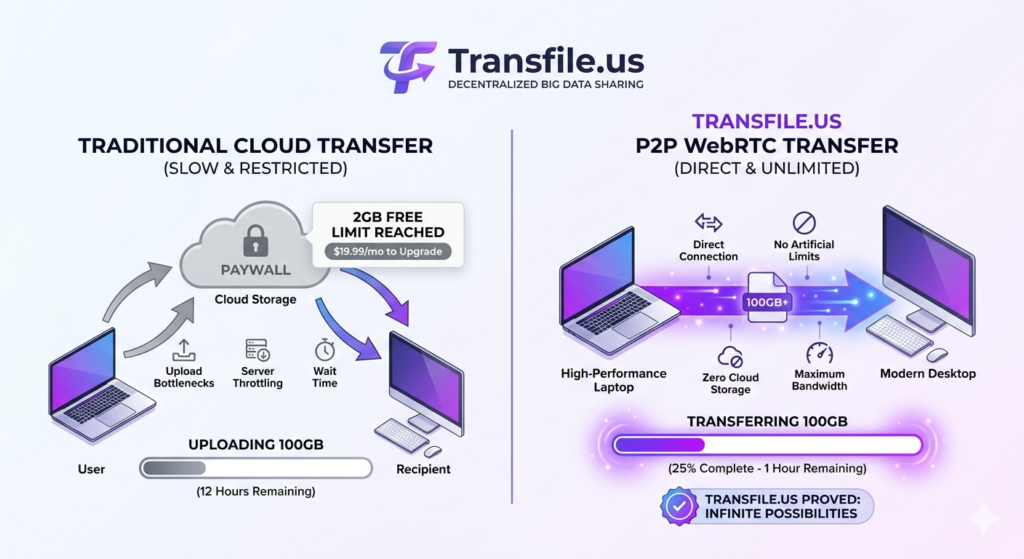
The Cloud Bottleneck: Why Traditional Transfers are Slow
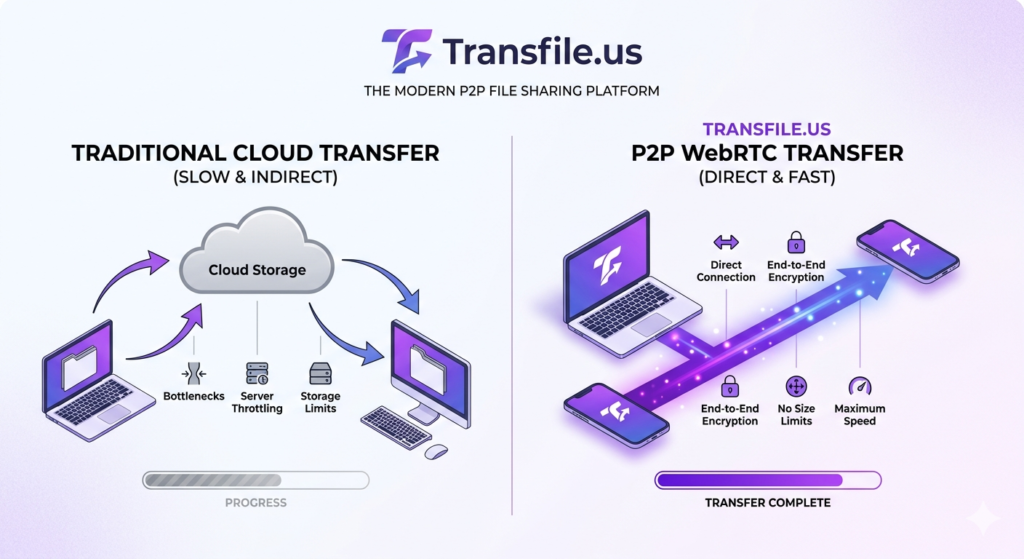
To understand why Transfile.us is faster, we must first look at the flaw in traditional services like Google Drive, Dropbox, or WeTransfer. These services use a “Centralized Storage” model.
- The Upload Phase: You upload the file from your computer to their server.
- The Storage Phase: The file sits on their hard drive, often being scanned or compressed.
- The Download Phase: Your recipient eventually clicks a link and downloads it from their server to their device.
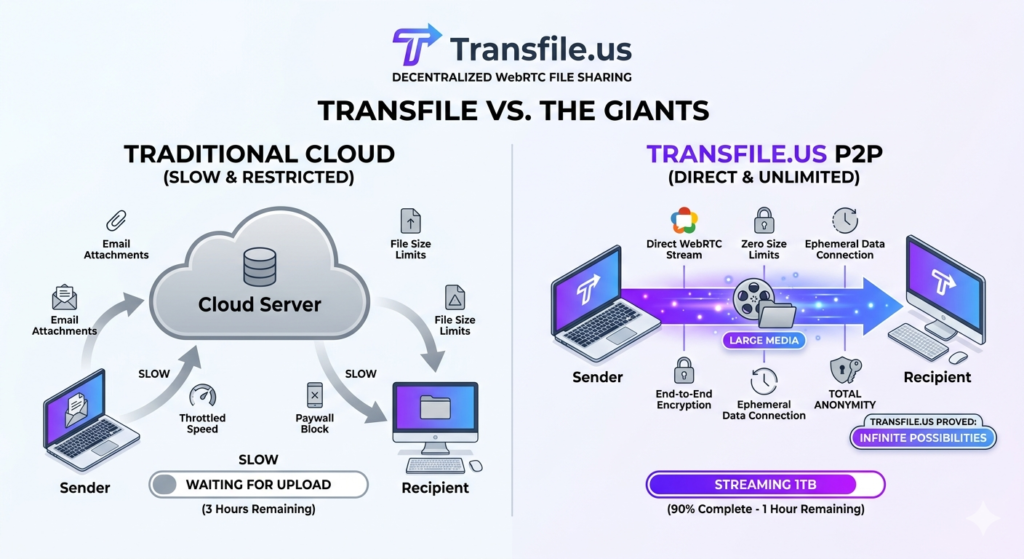
In this model, the file has to travel twice. If you have a 10GB file, you spend time uploading 10GB, and your friend spends time downloading 10GB. You are limited by the service’s server speed, their storage limits, and their terms of service.
Enter Transfile.us: The Power of P2P and WebRTC
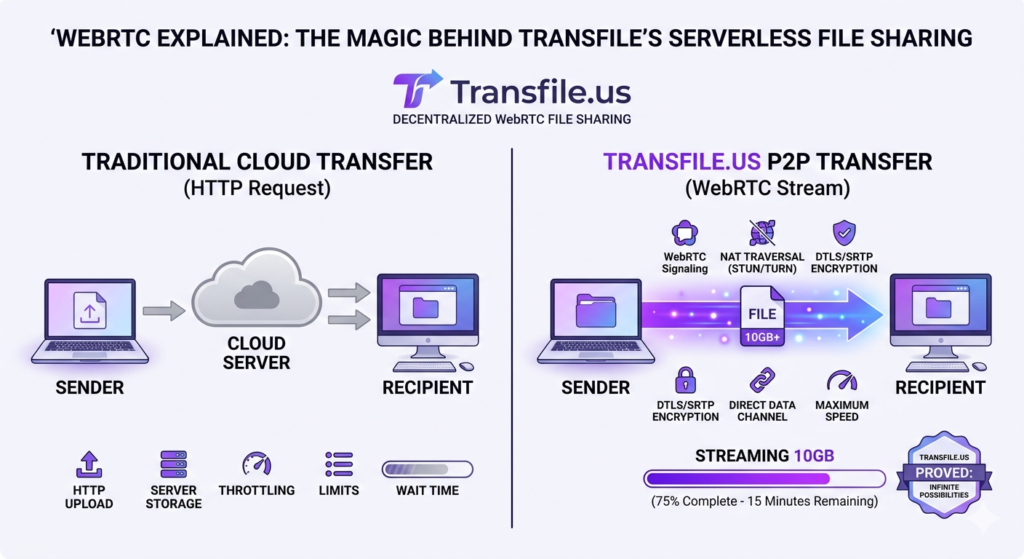
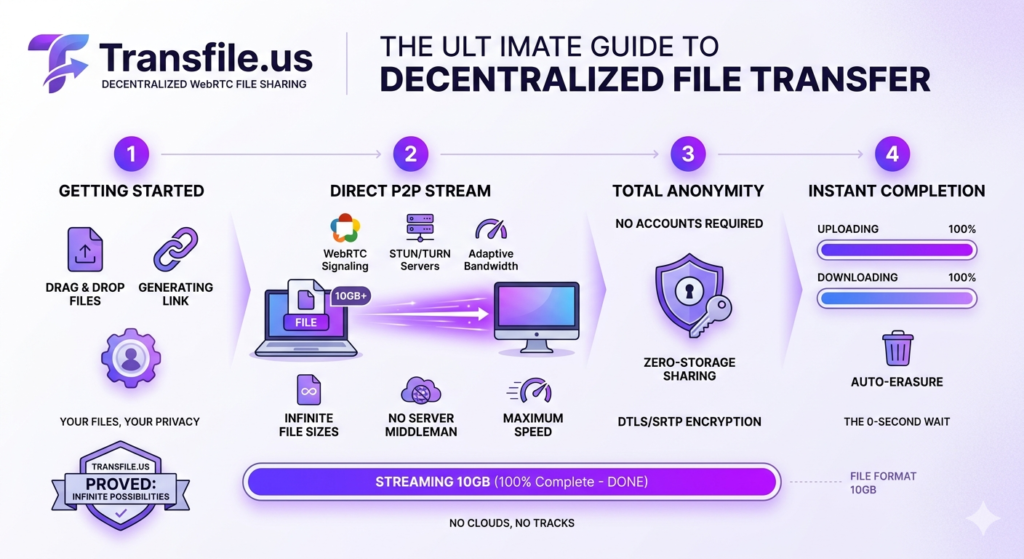
Transfile.us eliminates the “middleman.” By using WebRTC (Web Real-Time Communication), Transfile.us establishes a direct, encrypted “pipe” between two browsers.
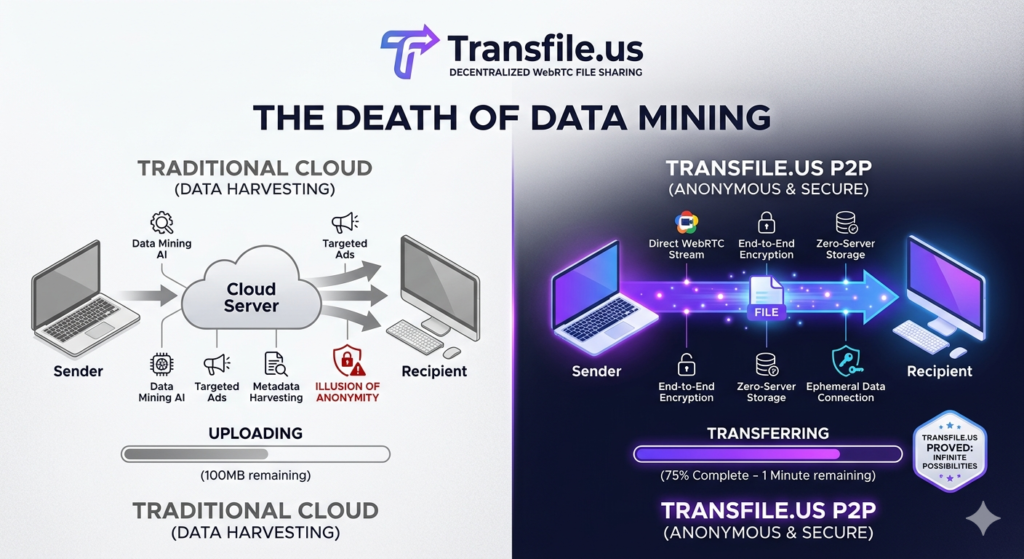
When you share a file via Transfile.us, the data flows directly from your device’s storage to the recipient’s device. There is no intermediate server involved in handling the actual file data. This is Peer-to-Peer (P2P) sharing at its finest.
How the “Zero-Upload” Magic Works
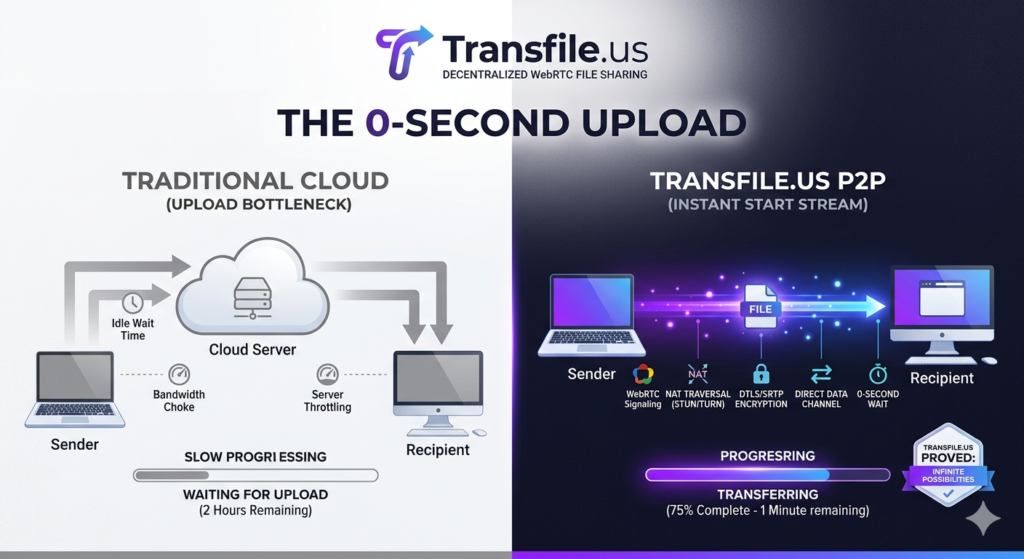
The term “Zero-Upload” might sound like science fiction, but it is a technical reality. On Transfile.us, when you select a file, the browser starts reading the binary data locally. As soon as the recipient connects via your unique link or Device ID, the data is “streamed” in real-time.
Because the data isn’t being stored in a cloud “bucket” first, the transfer happens at the maximum speed your connection allows. If you and your recipient are on the same local network, the speeds can be astronomical, far surpassing any commercial cloud provider.
5 Reasons Why Transfile.us is the Future of File Sharing
1. No Artificial Size Limits
Most cloud services cap free users at 2GB or 5GB. They want you to pay for a subscription. Transfile.us doesn’t store your files, which means we don’t have to pay for massive server farms. We pass that freedom to you. Whether it’s a 100MB PDF or a 200GB raw video project, Transfile.us handles it without asking for a credit card.
2. Privacy by Design (Decentralization)
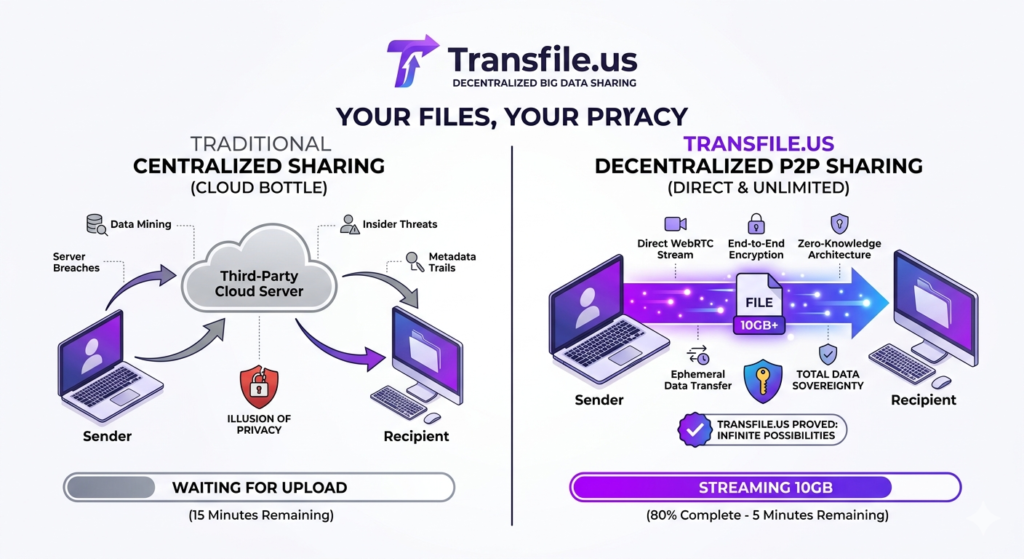
In an age of data breaches, privacy is paramount. When you upload a file to a cloud provider, you are essentially giving them a copy of your data. Transfile.us adopts a decentralized approach. Since the file never touches our servers, it is physically impossible for us (or anyone else) to peek at your content. Your privacy is protected by the laws of physics and end-to-end encryption.
3. Immediate Transfer Initiation
Traditional sharing requires you to wait for the upload to reach 100% before you can send the link. With Transfile.us, you send the link immediately. The transfer starts as soon as the recipient joins. This “Just-In-Time” delivery saves hours of productivity, especially for creative professionals working on tight deadlines.
4. End-to-End Encryption
Transfile.us leverages WebRTC’s native security protocols. All data channels are encrypted using DTLS (Datagram Transport Layer Security) and SRTP (Secure Real-time Transport Protocol). This ensures that even if someone were to intercept the data packets, they would be unreadable.
5. No Account, No Friction
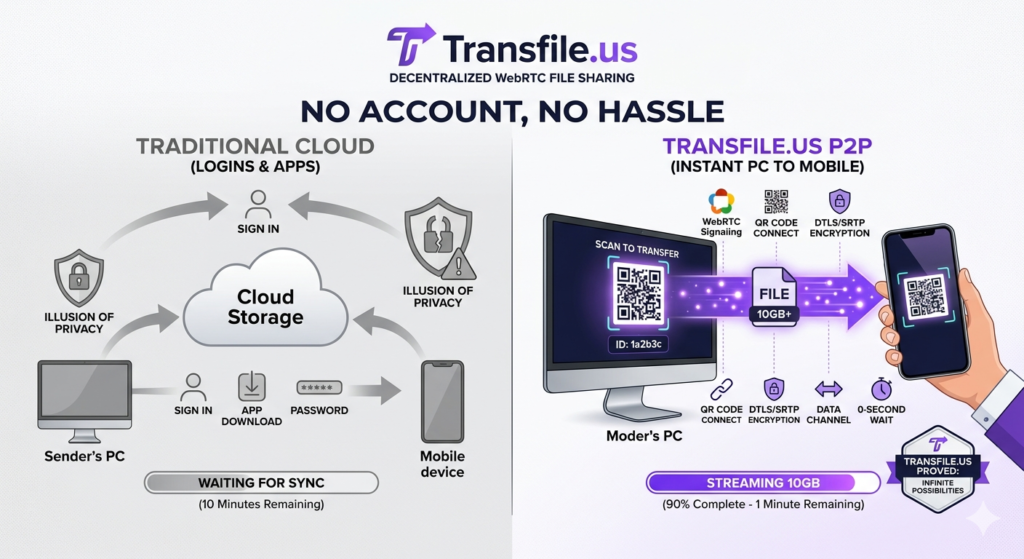
Marketing-heavy cloud services want your email address to send you newsletters. Transfile.us is a utility. We value your time. There are no sign-up forms, no password requirements, and no “confirm your email” hurdles. Open the site, pick your file, and share.
The Technical Edge: WebRTC vs. HTTP Uploads
For the tech-savvy, the difference lies in the protocol. Traditional uploads use HTTP/HTTPS, which is designed for fetching static content. WebRTC is designed for real-time interaction (like Zoom calls or online gaming).
By treating a file transfer like a “live stream” of data bits, Transfile.us avoids the overhead of traditional file handling. Furthermore, Transfile.us uses STUN and TURN servers to ensure that your P2P connection can penetrate even the most complex home routers and firewalls, making the experience seamless for the average user.
Use Cases: Who Benefits Most from Transfile.us?
- Video Editors: Sending 4K or 8K footage to colorists without waiting overnight for uploads.
- Developers: Sharing large database dumps or Docker images instantly with team members.
- Photographers: Delivering high-res RAW galleries to clients without paying for extra cloud storage.
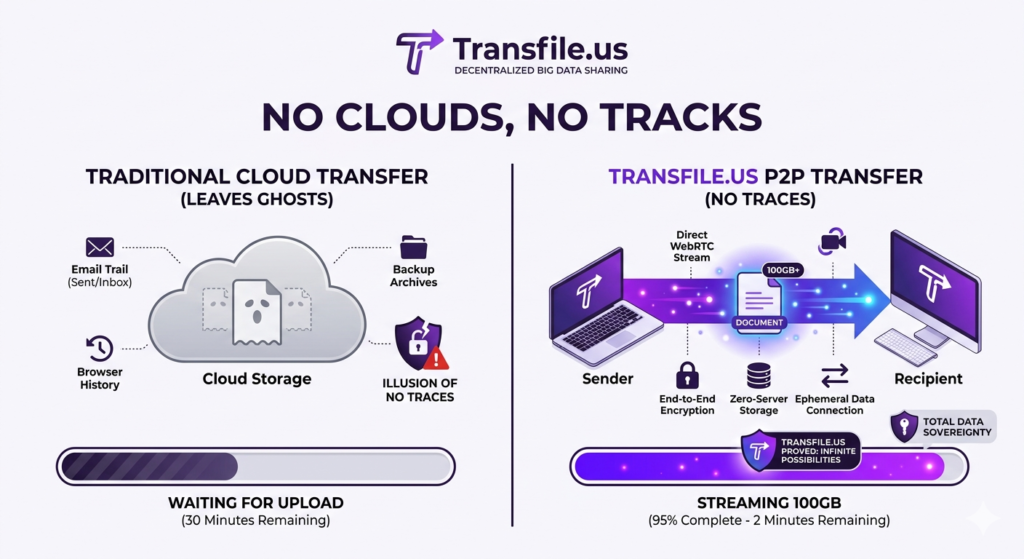
- Privacy Advocates: Sending sensitive legal or financial documents without leaving a digital footprint on a server.
- Everyday Users: Moving a large movie or a folder of vacation photos from a laptop to a phone without looking for a USB cable.
How to Optimize Your Experience on Transfile.us
To get the most out of this P2P technology, keep these three tips in mind:
- Keep the Tab Open: Since there is no server storage, both the sender and receiver must keep the Transfile.us browser tab open until the progress bar reaches 100%.
- Stable Connection: P2P relies on the stability of both parties. A wired Ethernet connection will always outperform Wi-Fi for massive transfers.
- Disable Heavy VPNs: While Transfile.us works with VPNs, some high-security VPNs may slow down WebRTC handshakes. If you experience slow speeds, try a direct connection.
Conclusion: Reclaiming the Internet’s Original Vision
The internet was originally designed to be a decentralized web of connected peers. Over time, we moved toward a centralized model where a few giant companies controlled all the data flow. Transfile.us is a step back toward that original vision—a faster, more private, and more efficient internet.
Stop being a slave to the “Cloud Uploading” screen. Experience the speed of direct Peer-to-Peer technology. Whether you are sending a simple document or a massive archive, Transfile.us ensures your data moves as fast as the speed of light.
Ready to send your first file? Visit Transfile.us and witness the power of P2P.