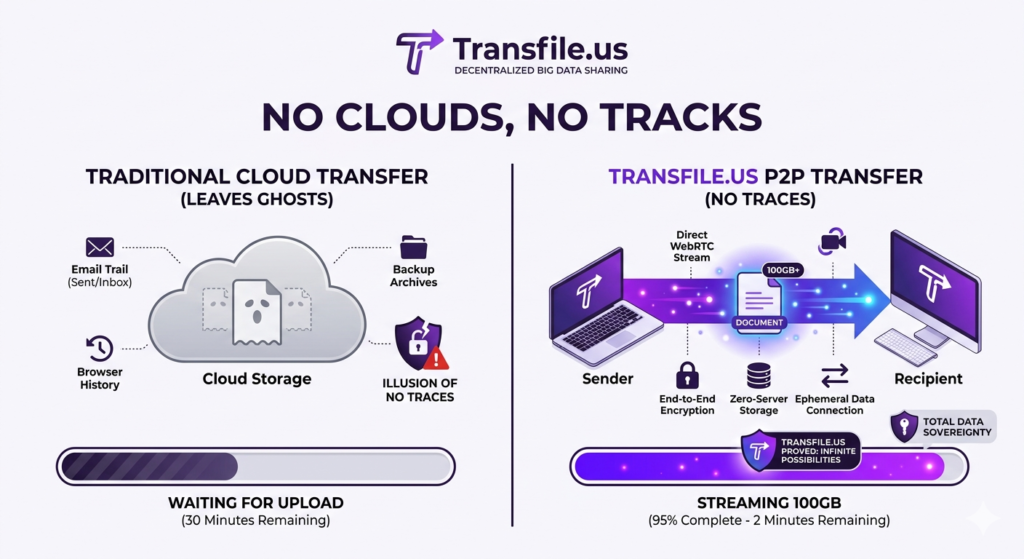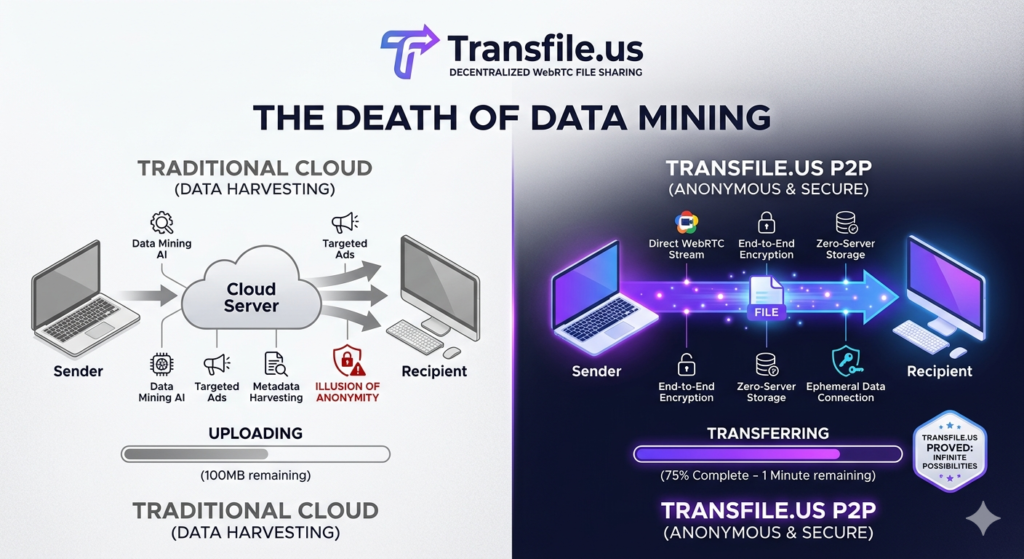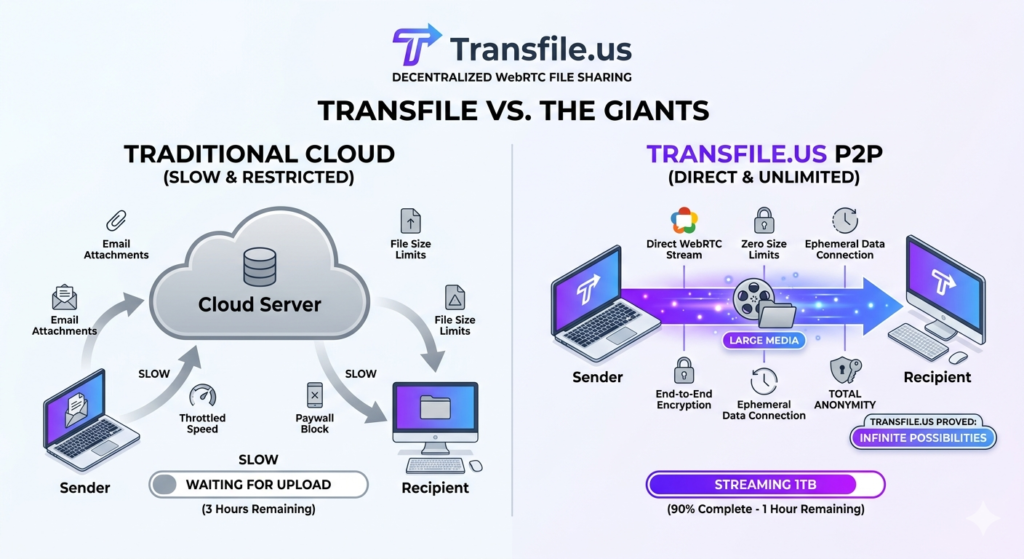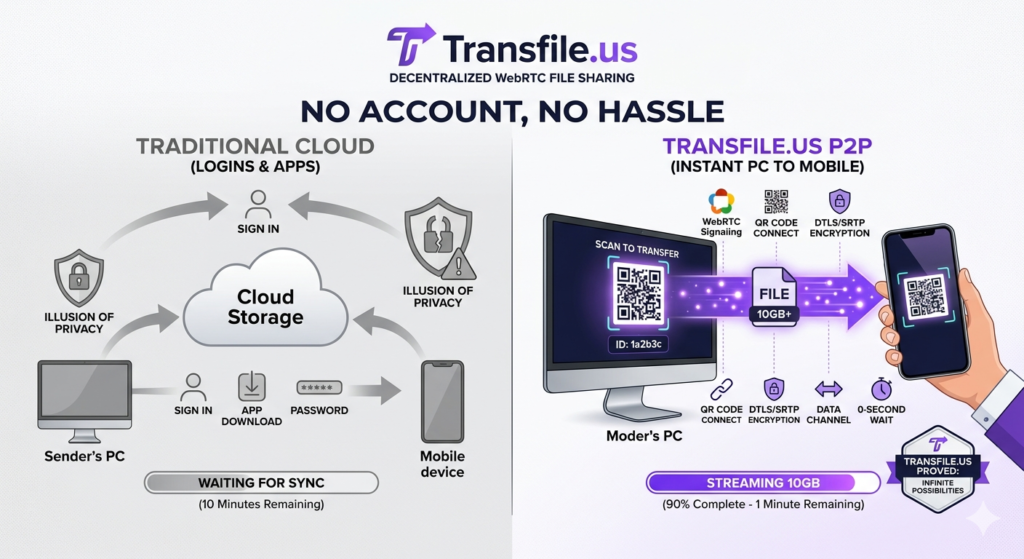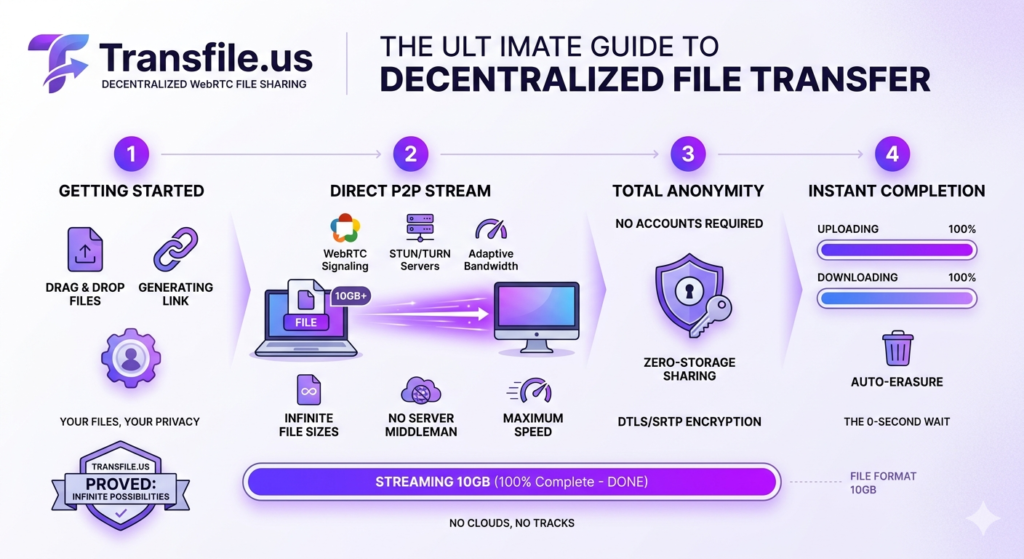
For the average internet user, there is a painful, lopsided reality to their connection. You might have a “high-speed” plan that allows you to download a movie in minutes, but the moment you try to send a large file to someone else, everything grinds to a halt. This is the Asymmetric Internet Bottleneck—the massive gap between download and upload speeds.
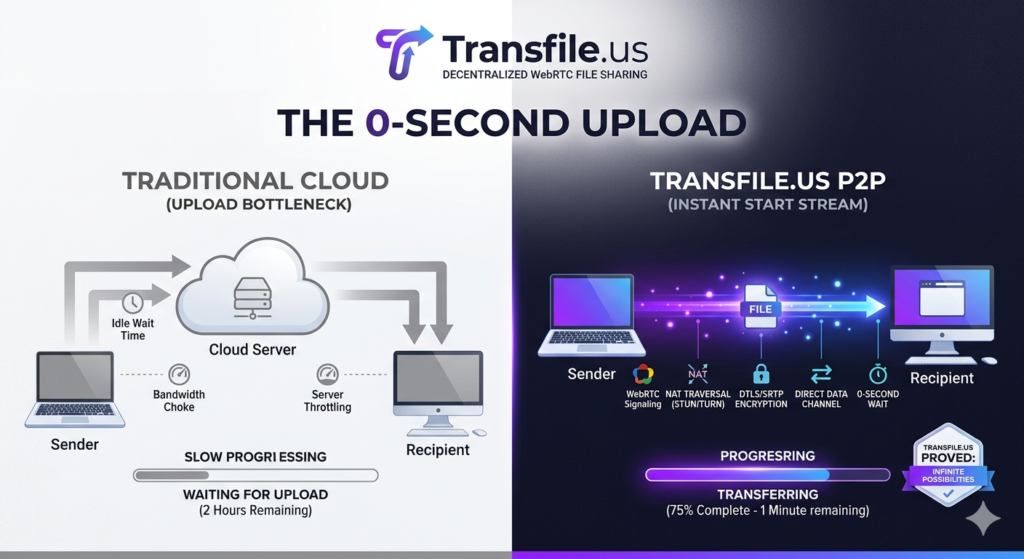
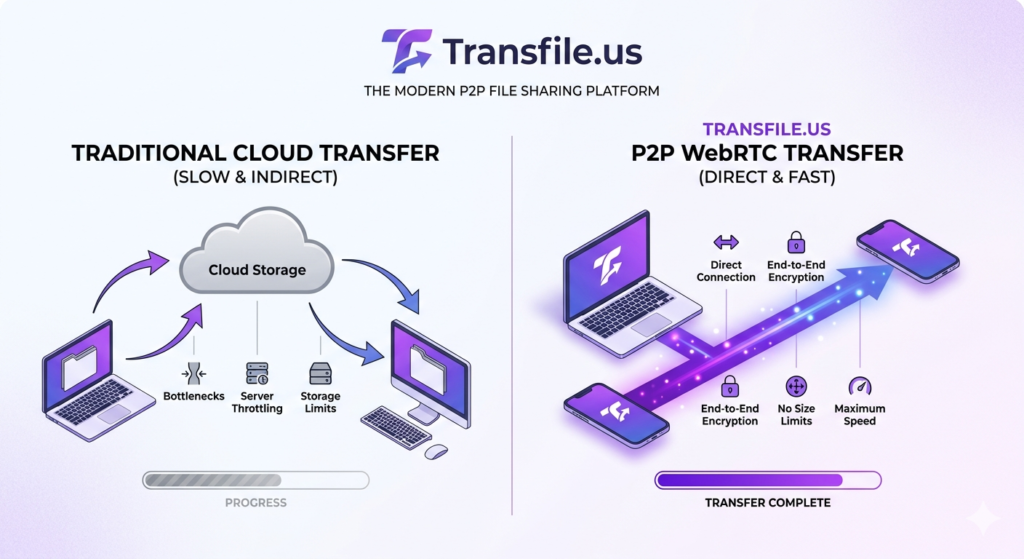
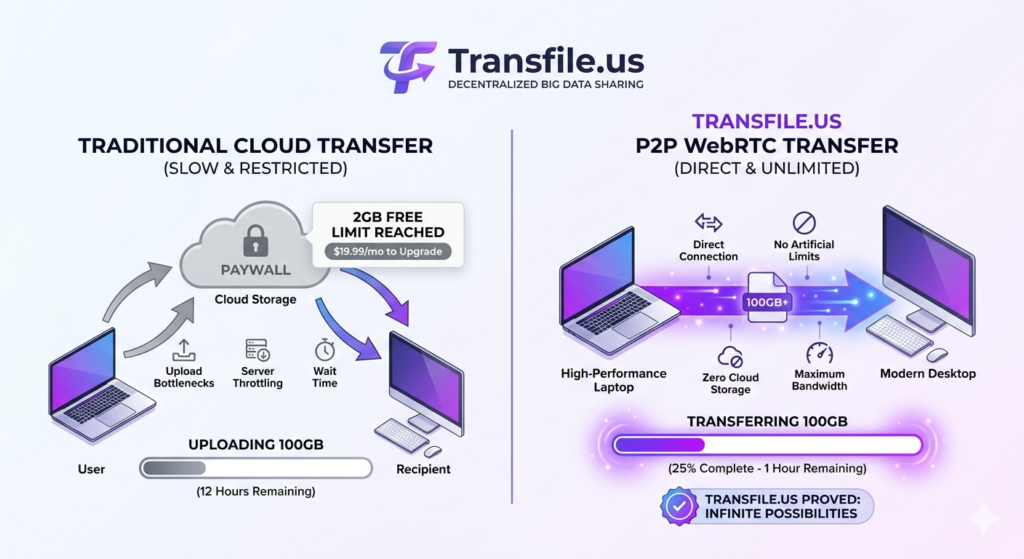
Technical comparison of traditional cloud upload bottlenecks vs instant P2P stream on Transfile.us with violet color accents.
In a world increasingly driven by high-definition media, remote work, and massive data sets, waiting for a file to “upload” to a cloud server is the single biggest drain on digital productivity. Transfile.us has arrived with a radical solution: The 0-Second Upload. By leveraging Peer-to-Peer (P2P) technology, we have fundamentally changed the math of file sharing, allowing you to bypass the cloud and start your transfer instantly.
Understanding the Asymmetric Bottleneck
Most residential and even some business internet connections are “asymmetric.” This means your Download Speed (the speed at which you receive data) is much higher than your Upload Speed (the speed at which you send data). It is common to see plans like “300 Mbps Download / 20 Mbps Upload.”
In the traditional cloud model (Google Drive, Dropbox, WeTransfer), this bottleneck is a double-edged sword:
- The Idle Wait: You have to push your entire file through that narrow 20 Mbps “upload straw” to reach a cloud server.
- The Dead Time: The recipient cannot start their high-speed download until your slow upload is 100% finished.
If you are sending a 20GB project, you might be staring at a progress bar for over two hours. During that time, your bandwidth is choked, and your recipient is doing nothing but waiting.
The Transfile Solution: What is a “0-Second Upload”?
The term “0-second upload” doesn’t mean the laws of physics have been broken; it means the waiting period for the upload to complete has been eliminated.
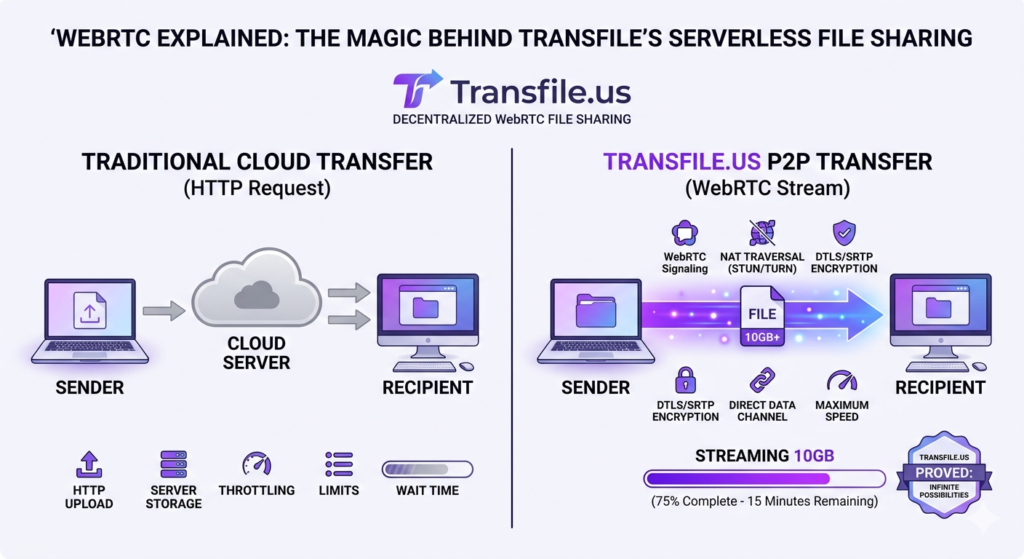
On Transfile.us, we use WebRTC (Web Real-Time Communication) to create a direct stream between the sender and the receiver.
- Instant Start: As soon as you select a file and your recipient clicks “Accept,” the data begins moving.
- Simultaneous Action: The “uploading” from your computer and the “downloading” to their computer happen at the exact same time.
- No Buffer Time: There is no intermediate server that needs to “receive and store” the file before it can be handed over.
By merging the upload and download phases into one single, real-time event, Transfile.us effectively “solves” the bottleneck by making the recipient’s download speed work for you.
Why P2P is the Only Way to Bypass Slow Speeds
In a centralized cloud system, the server is the gatekeeper. It dictates when the transfer starts and finishes. In the P2P model used by Transfile.us, the gate is removed.
1. Direct Pipe Connectivity
When you use Transfile.us, your browser establishes a direct “pipe” to the other person. If you are on a slow upload connection, the recipient’s browser acts as a “puller,” requesting data packets as fast as your connection can physically push them. Because there is no “processing” or “virus scanning” on a middleman server, every bit of your available bandwidth goes directly toward the final destination.
2. Eliminating Server Throttling
Cloud giants often throttle (slow down) the connections of free users to save on their own operational costs. They don’t want you using up their expensive server bandwidth. Transfile.us doesn’t have this conflict of interest. Since we don’t host the file, we don’t throttle your speed. You get 100% of what your ISP provides.
3. Local Network Optimization
This is the ultimate bottleneck-killer. If you are sending a file to someone in the same building or on the same Wi-Fi network, WebRTC is smart enough to detect this. Instead of sending data out to the internet (slow upload) and back in, it moves the data across your Local Area Network (LAN). In this scenario, a transfer that would take an hour on the cloud takes seconds on Transfile.us.
The Productivity Ripple Effect
For businesses and creators, time is the most expensive resource. The “0-second upload” philosophy creates a massive ripple effect in workflow efficiency:
- Video Production: An editor can start reviewing a clip the moment the cinematographer starts the transfer. They don’t have to wait for a “Link is Ready” email three hours later.
- Software Engineering: Large builds or assets can be swapped between team members instantly during a “live” debugging session.
- Client Deliverables: Instead of telling a client, “I’ll send the link when it’s done uploading,” you can say, “Join this link now, and you’ll have it in minutes.”
Security in the Fast Lane
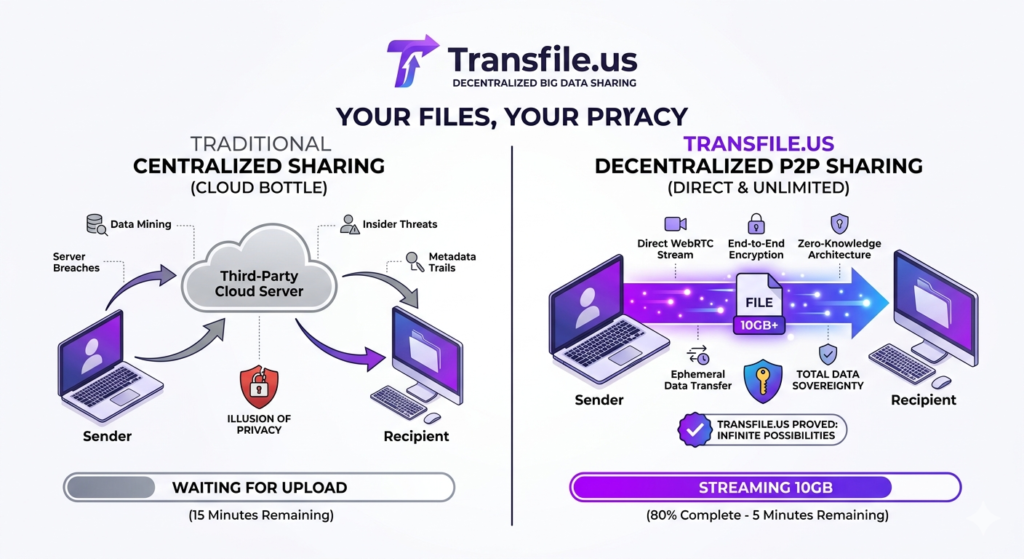
Faster doesn’t mean less secure. In fact, the “live” nature of a Transfile.us transfer adds a layer of security. Since the file is never stored on a server, there is no “dormant” data waiting to be hacked. The transfer is End-to-End Encrypted (E2EE), meaning that the high-speed data stream is a private conversation between two browsers that no one else can eavesdrop on.
How to Maximize Your Transfer Speeds
To truly conquer the upload bottleneck, follow these professional tips on Transfile.us:
- Use Wired Connections: If you are the sender (the one with the slow upload), plugging into an Ethernet cable can provide a much more stable and slightly faster “push” than Wi-Fi.
- Close Background Apps: Apps like Zoom, YouTube, or cloud backup services (like OneDrive or iCloud) compete for your limited upload bandwidth. Close them during a large Transfile transfer.
- Modern Browsers Matter: We recommend Google Chrome or Microsoft Edge for the best WebRTC performance, as their engines are highly optimized for direct data streaming.
Conclusion: Reclaiming Your Time
The “Upload Bottleneck” is a legacy problem caused by an outdated way of thinking about the web. We were told we had to upload to the cloud because our devices weren’t powerful enough to talk to each other. That is no longer true.
Transfile.us leverages the power of your modern browser to turn your device into a high-performance broadcasting station. By removing the server, we remove the wait. The 0-second upload isn’t just a feature; it’s a new standard for how we interact with our digital world.
Stop waiting. Start streaming. Solve your upload bottleneck now at Transfile.us.