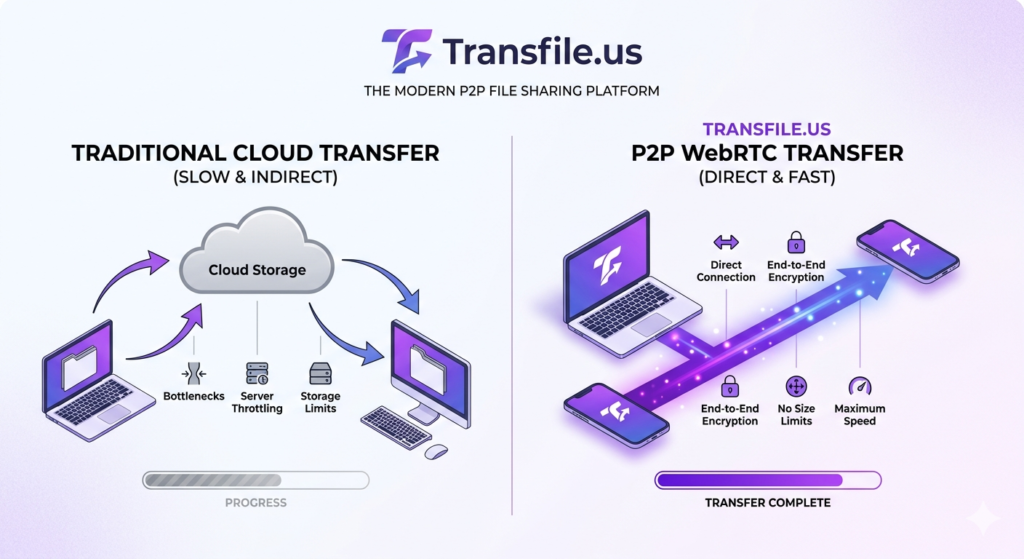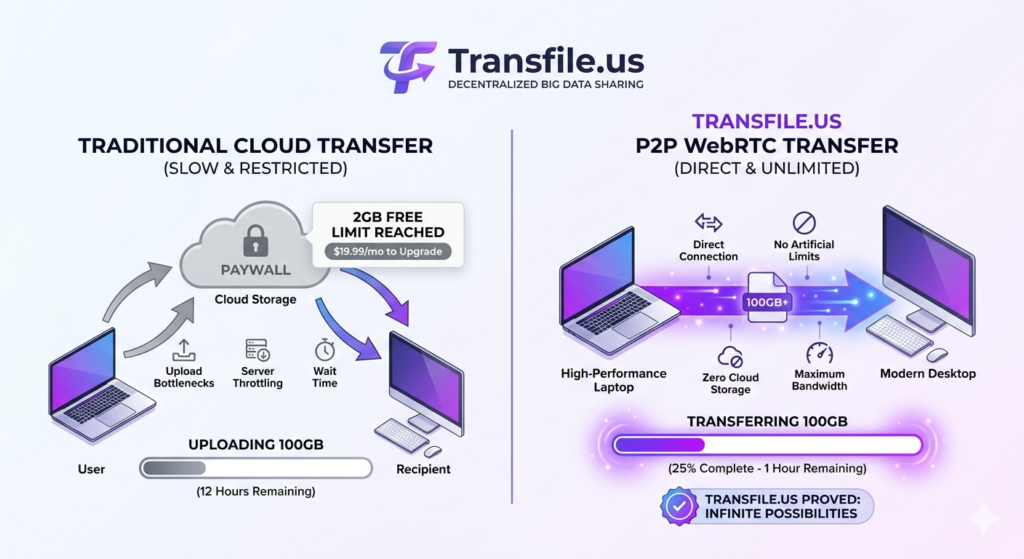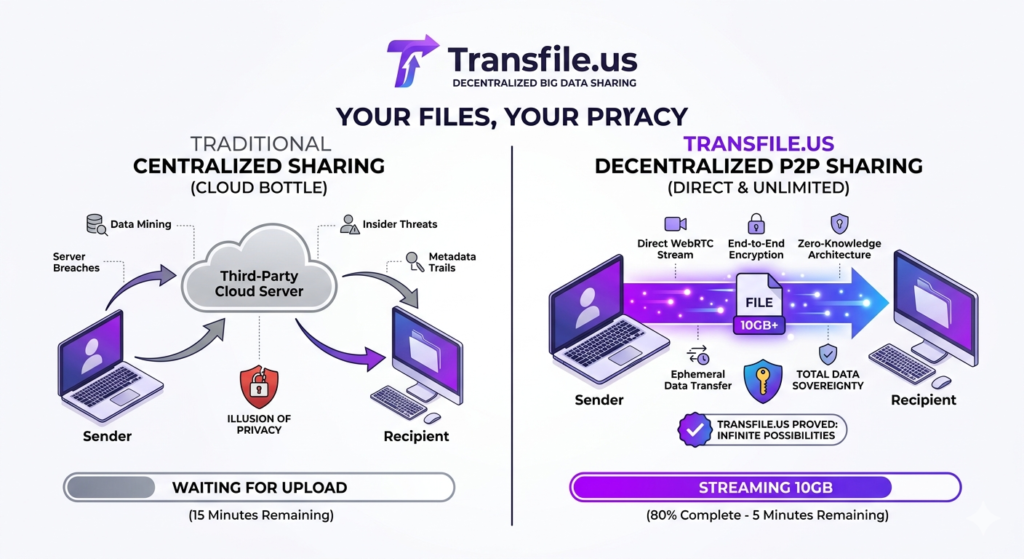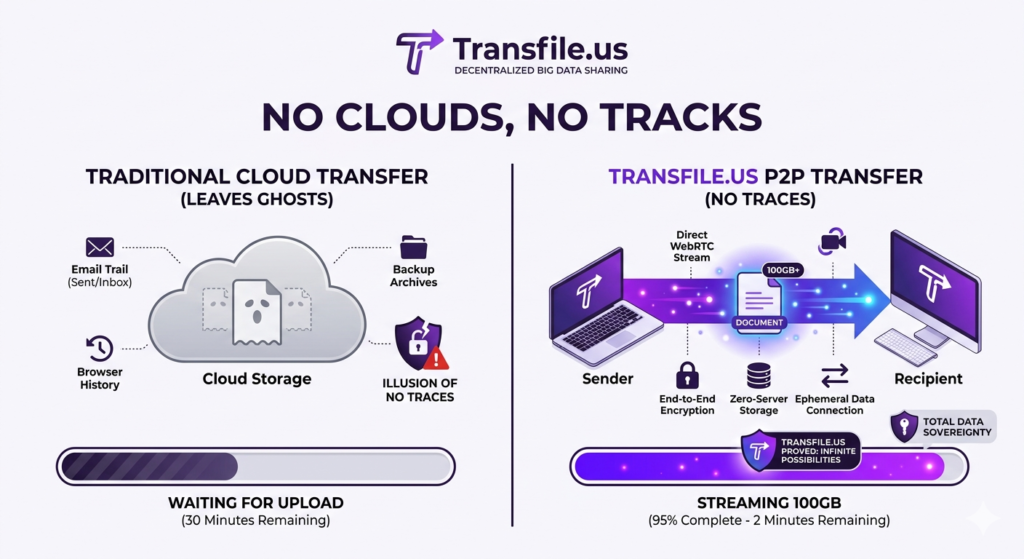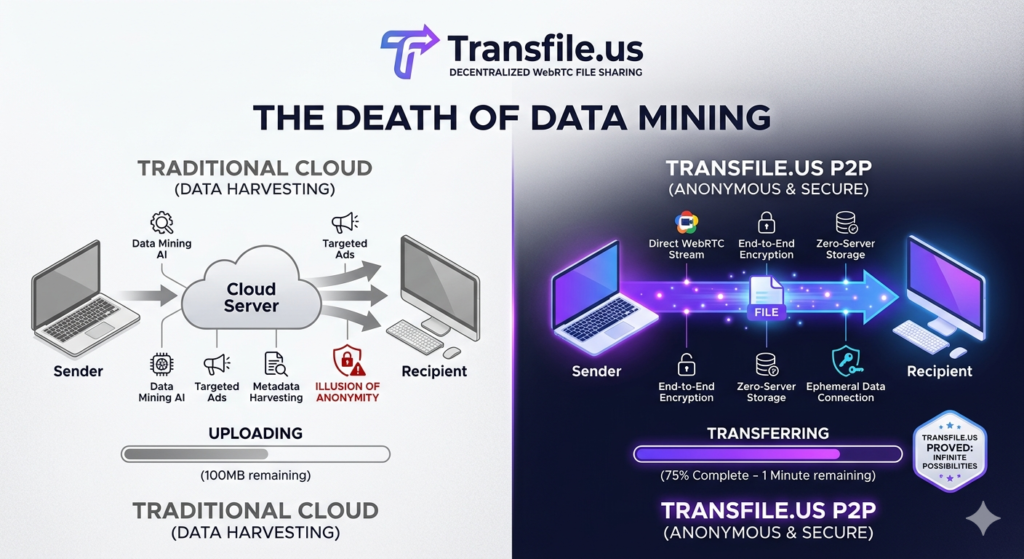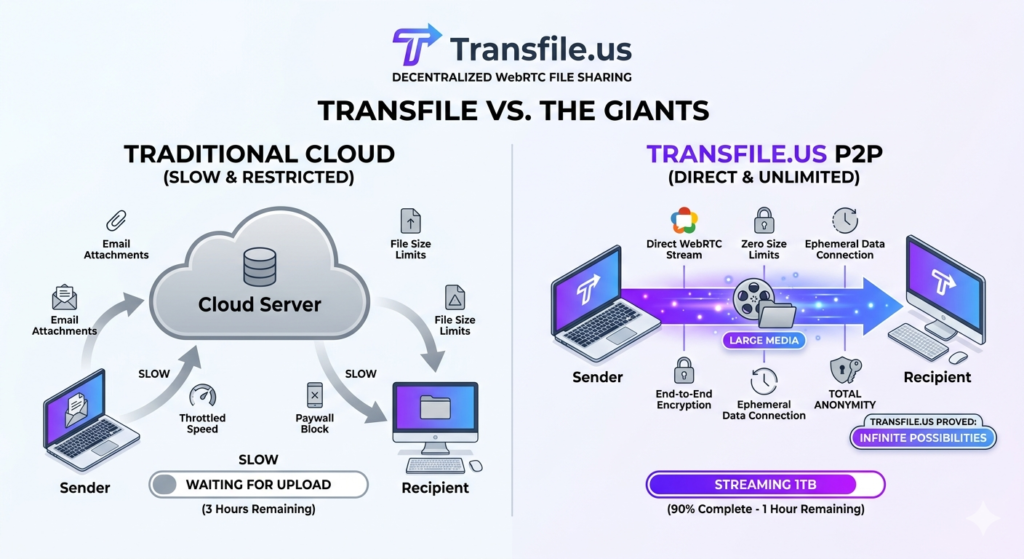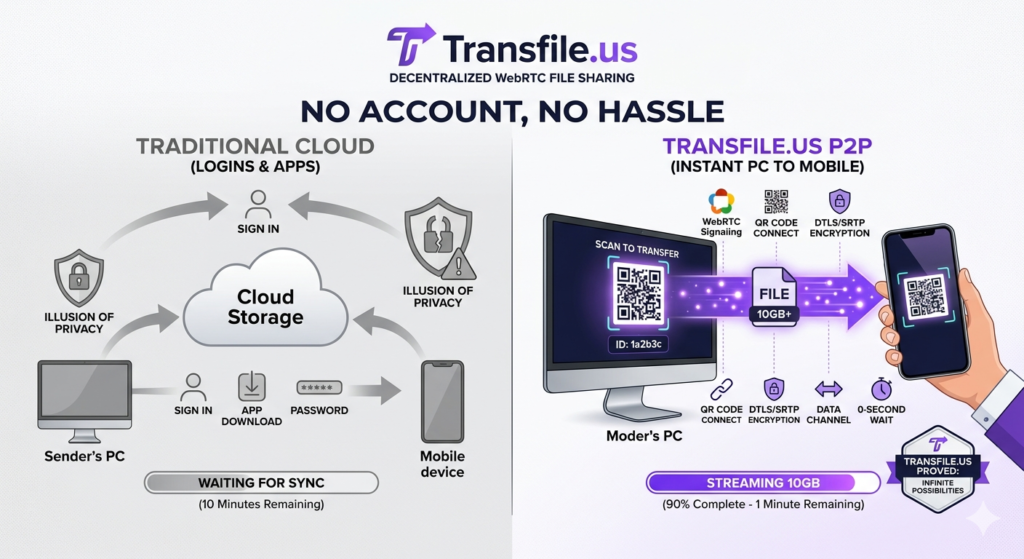
For decades, the internet has functioned on a “Hub and Spoke” model. If you wanted to send a file to someone, you first had to send it to a central hub—a server owned by a corporation. We grew comfortable with this “Cloud” model, but as our data became larger and our privacy became more fragile, the cracks in the system began to show. Slow upload speeds, subscription paywalls, and data mining have turned simple file sharing into a digital chore.
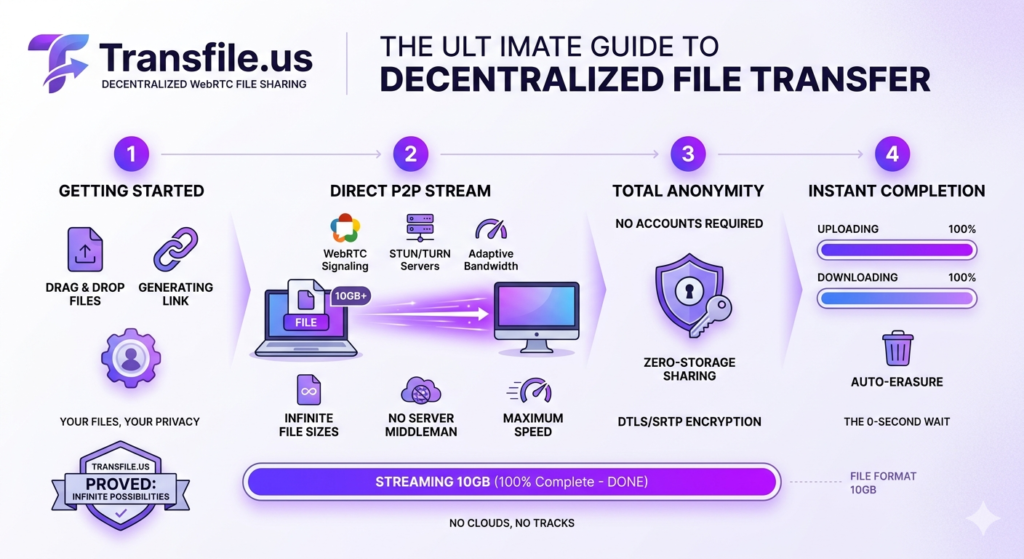
Comprehensive infographic with violet branding detailing the 4-step process of using Transfile.us for decentralized P2P sharing
Enter the era of Decentralized File Transfer. This is not just a minor update to how we share files; it is a total reimagining of the web. By using Transfile.us, you are stepping into a world where your device talks directly to another device, bypassing the cloud entirely. This ultimate guide will walk you through the technology, the benefits, and exactly how to master the “Serverless” way of sharing.
What is Decentralized File Transfer?
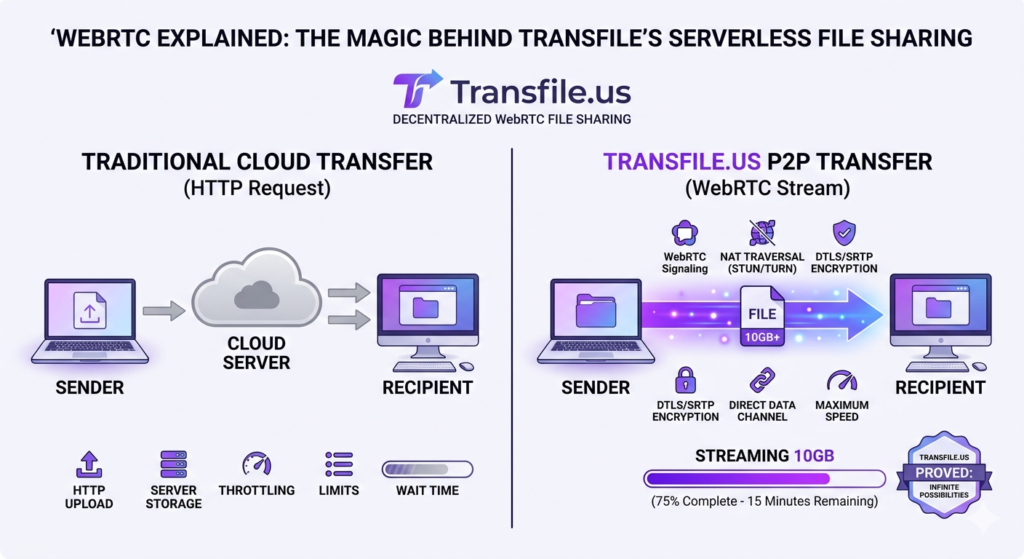
In a traditional transfer, your file is “Uploaded” to a server (Storage), then “Downloaded” by the recipient. Decentralized transfer, powered by WebRTC (Web Real-Time Communication), creates a direct Peer-to-Peer (P2P) connection.
Think of it this way: Traditional sharing is like sending a letter through a massive postal sorting facility where it might sit for days. Decentralized sharing is like handing a folder directly to a friend standing right in front of you. Even if that “friend” is on the other side of the planet, the connection is direct, private, and instant.
Why Choose Transfile.us?
Transfile.us was built to solve the three biggest frustrations of the modern web: Speed, Privacy, and Limits.
- No Server Middleman: Your files never touch our hard drives. We facilitate the “handshake” between browsers, and then the data flows privately.
- Infinite File Sizes: Because we don’t store the data, we don’t have to charge you for storage. Send 100GB, 500GB, or even a Terabyte of data for free.
- Total Anonymity: No sign-ups. No email addresses. No tracking. You remain a guest on our platform, every single time.
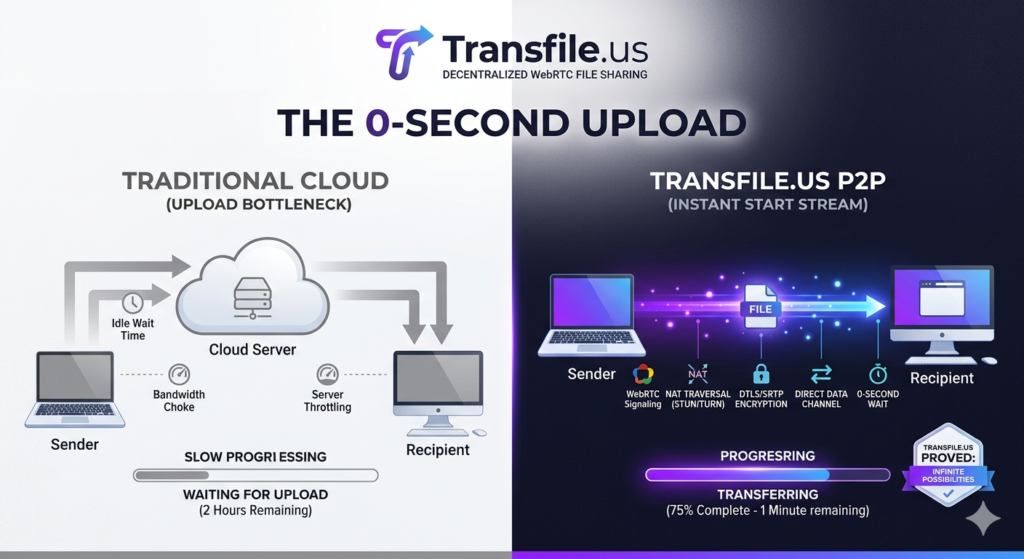
- Instant Streaming: The recipient begins receiving the file the moment you start sending it. No more waiting for “100% Uploaded.”
Step-by-Step: Your First Decentralized Transfer
Getting started with Transfile.us is designed to be frictionless. You don’t need to install any software or configure any complex network settings.
Step 1: Prepare Your File
Open your modern web browser (Chrome, Edge, Firefox, or Safari) and go to Transfile.us. Simply drag and drop the files or folders you wish to send into the violet-themed interface.
Step 2: Establish the Handshake
Once the file is selected, Transfile.us generates a unique connection link. You have three ways to share this:
- Direct Link: Copy the URL and send it via your preferred secure messaging app.
- 6-Digit ID: Perfect for manual entry on another device.
- QR Code: The fastest way to bridge the gap between a PC and a mobile device.
Step 3: The Live Stream
The recipient opens the link and clicks “Accept.” At this moment, a WebRTC Data Channel is created. You will see a real-time progress bar on both screens. Crucial Note: Both browsers must stay open until the transfer reaches 100%. Since this is a “live” stream, closing the tab will cut the connection.
Step 4: Completion and Erasure
Once the progress bar hits 100%, the file is safely on the recipient’s device. Close the tab, and the “tunnel” is destroyed instantly. No digital footprint remains.
The Science of P2P: How It Works Under the Hood
For the technically curious, Transfile.us utilizes several advanced protocols to ensure your data gets through even the toughest firewalls:
- STUN/TURN Servers: These help your browser navigate through routers and NAT (Network Address Translation) to find the most direct path to your peer.
- DTLS & SRTP: These are the gold standards of encryption. Your data is encrypted at the source and can only be decrypted by the recipient’s browser. Not even an ISP or a hacker “listening in” can read the content.
- Adaptive Bandwidth: Transfile.us intelligently detects the connection speed of both parties and adjusts the data flow to prevent crashes or lag, ensuring the most stable transfer possible.
Best Practices for “Power Users”
To get the most out of your decentralized sharing experience, follow these professional tips:
1. Optimize Your Network
For massive transfers (over 50GB), use a wired Ethernet connection. While WebRTC works beautifully on Wi-Fi, a cable reduces packet loss and provides a more consistent “push” for long-duration streams.
2. Disable Sleep Mode
Ensure that both the sending and receiving computers are set to “Never Sleep” while the transfer is active. If a laptop lid is closed or a phone screen locks, the browser may pause the WebRTC process.
3. Use Incognito Mode
If you are working on a public computer or a shared workstation, use your browser’s “Incognito” or “Private” mode. This adds an extra layer of privacy by ensuring your local browser history doesn’t even record that you performed a transfer.
Common Myths About Decentralized Sharing
- “Is it like Torrenting?” While they both use P2P technology, Transfile.us is private. Torrenting involves sharing a file with a “swarm” of thousands of strangers. Transfile.us is a 1-on-1 private conversation.
- “Is it slower than the Cloud?” Often, it is faster. Because you skip the “Upload to Server” phase and move directly to the “Download” phase, the total time saved is significant.
- “Do I need a special browser?” No. Any modern browser that supports WebRTC (which is nearly 98% of all browsers today) works perfectly.
Conclusion: The Future belongs to the Peer-to-Peer Web
The “Ultimate Guide” to file sharing isn’t about finding a bigger cloud; it’s about realizing you don’t need the cloud at all. Transfile.us represents the next step in our digital evolution—a return to a decentralized, efficient, and private internet.
Whether you are a creative professional moving terabytes of media, a lawyer protecting sensitive documents, or just someone trying to move photos from a PC to a phone, decentralized transfer is the solution you’ve been waiting for. It is fast, it is free, and it is finally under your control.
Stop uploading. Start streaming. Join the decentralized revolution today at Transfile.us.