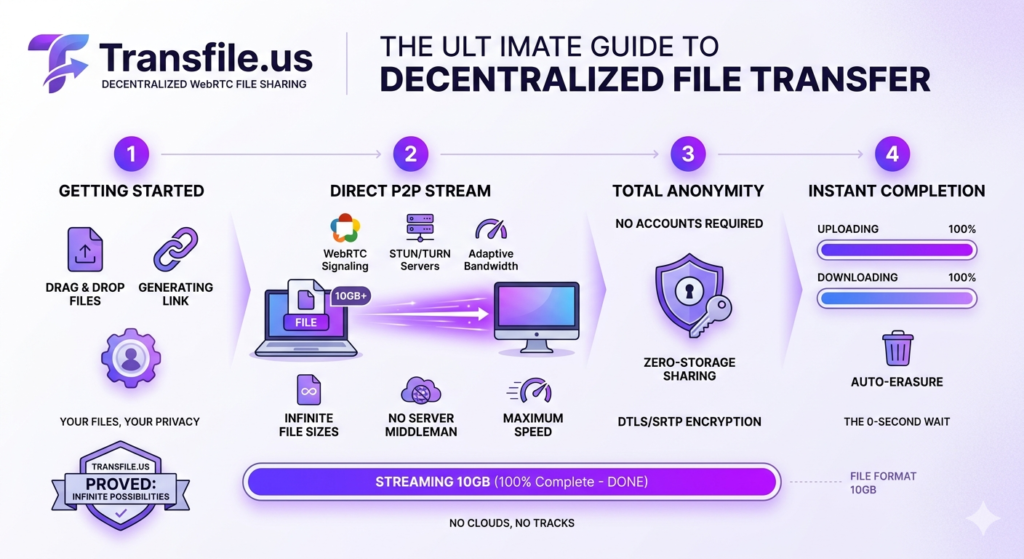
In the current digital landscape, the phrase “the cloud” has become synonymous with convenience. We store our photos, medical records, legal documents, and corporate secrets on servers owned by a handful of global tech giants. However, this convenience comes with a hidden, often ignored price: the total loss of data sovereignty.
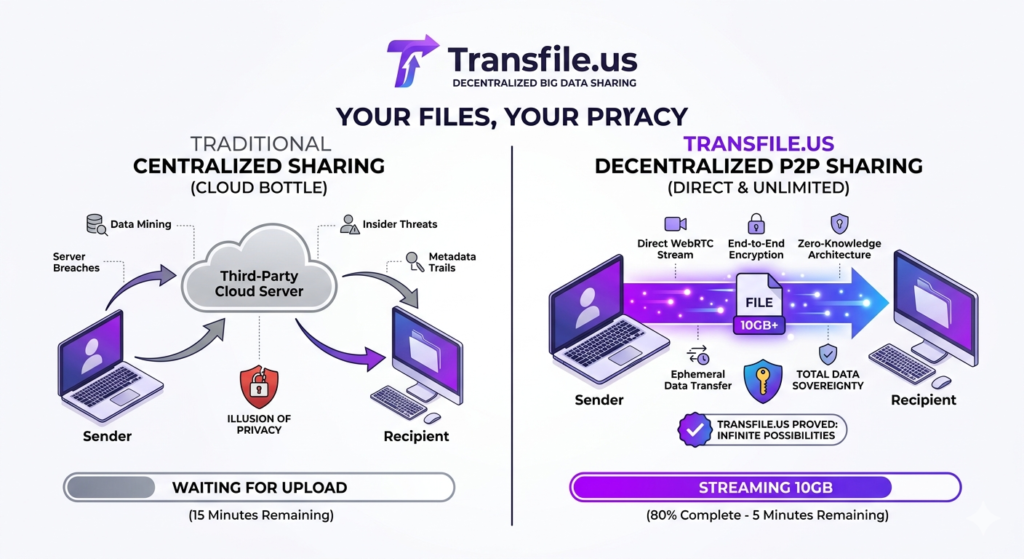
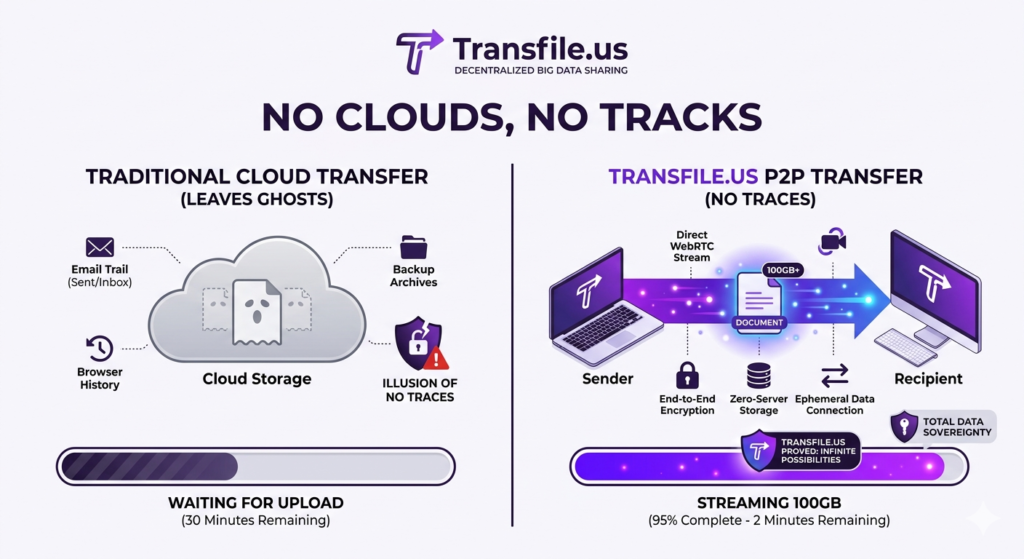
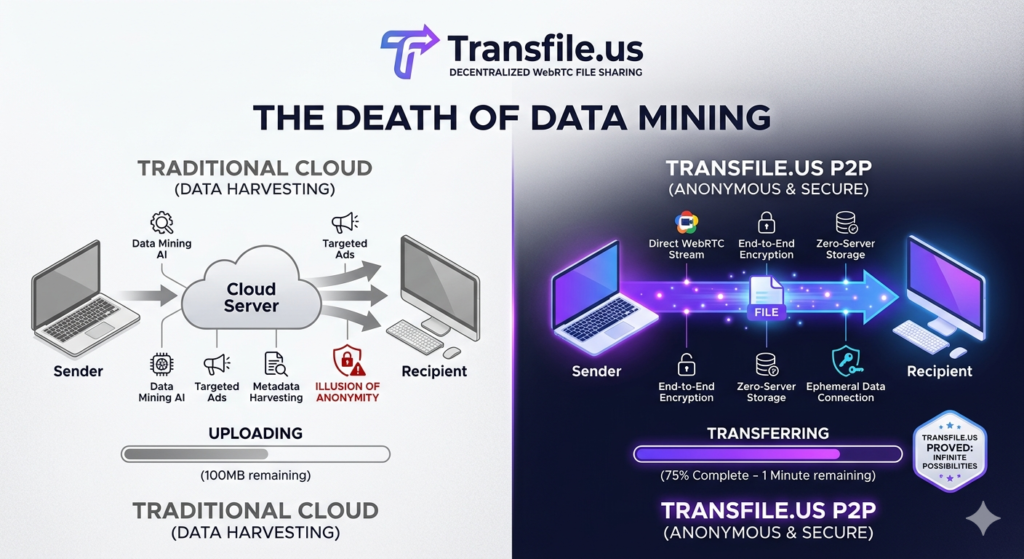
Transfile.us conceptual diagram comparing cloud security illusion versus P2P decentralized data sovereignty and total privacy.
Every time you upload a file to a centralized cloud provider, you are essentially handing over a copy of your life to a third party. You trust them to keep it safe, but history has shown that even the biggest fortresses have cracks. This is why a paradigm shift is happening. The future of data security isn’t a “bigger cloud”—it is Decentralized Sharing. Platforms like Transfile.us are leading this charge, proving that the safest way to store your data on a server is to never put it there in the first place.
The Illusion of Privacy in Centralized Systems
Most users believe that because they have a password, their cloud files are private. This is a dangerous misconception. Traditional cloud storage operates on a centralized model where the service provider holds the “keys” to the kingdom.
- Data Mining: Many free cloud services scan your files to build advertising profiles.
- Server Breaches: If a central server is hacked, millions of users’ private data are exposed at once.
- Government Surveillance: Centralized companies are subject to subpoenas and “gag orders,” meaning they can hand over your data to authorities without you ever knowing.
- Insider Threats: Employees of cloud companies can, and sometimes do, access user data without authorization.
Decentralized sharing, or Peer-to-Peer (P2P) sharing, eliminates these risks by removing the central point of failure.
What is Decentralized Sharing?
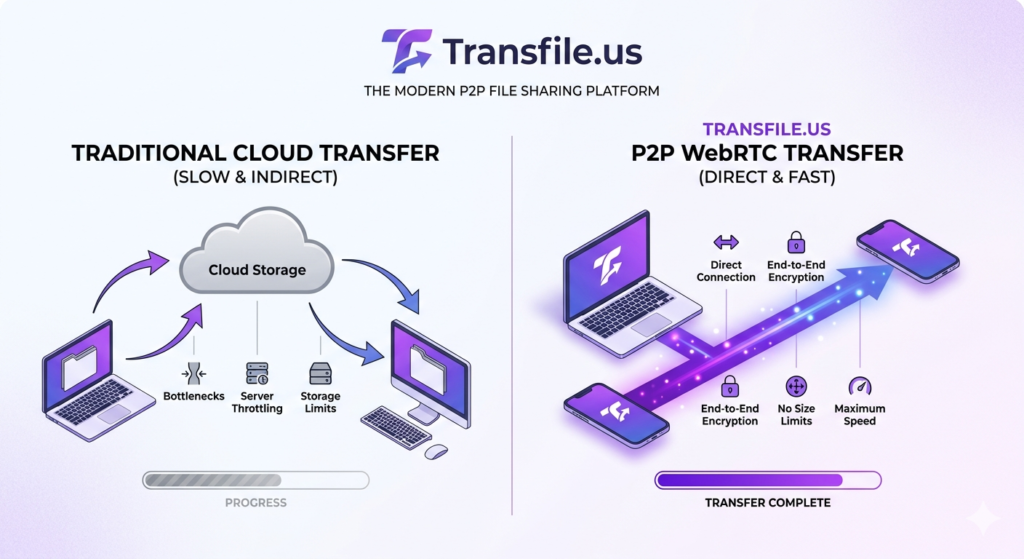
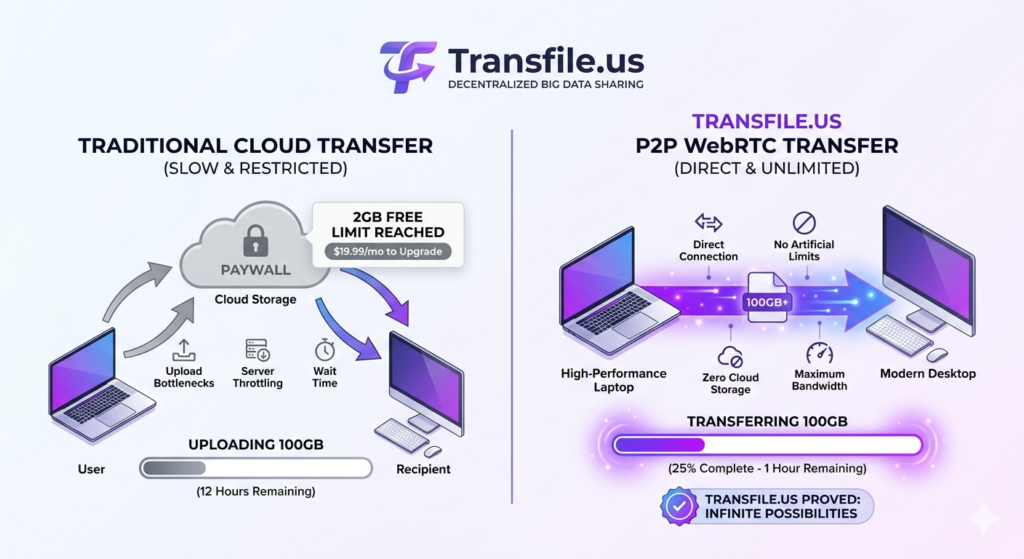
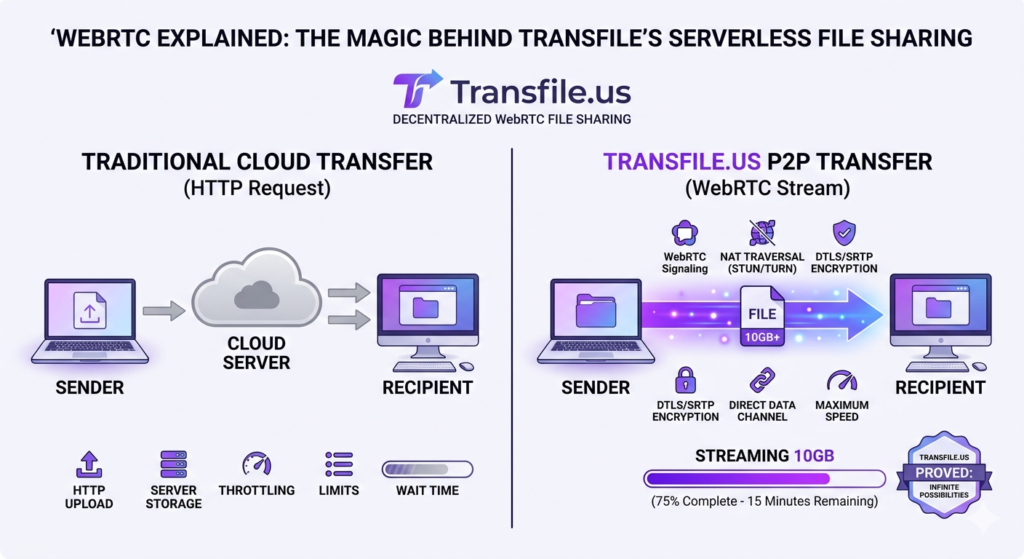
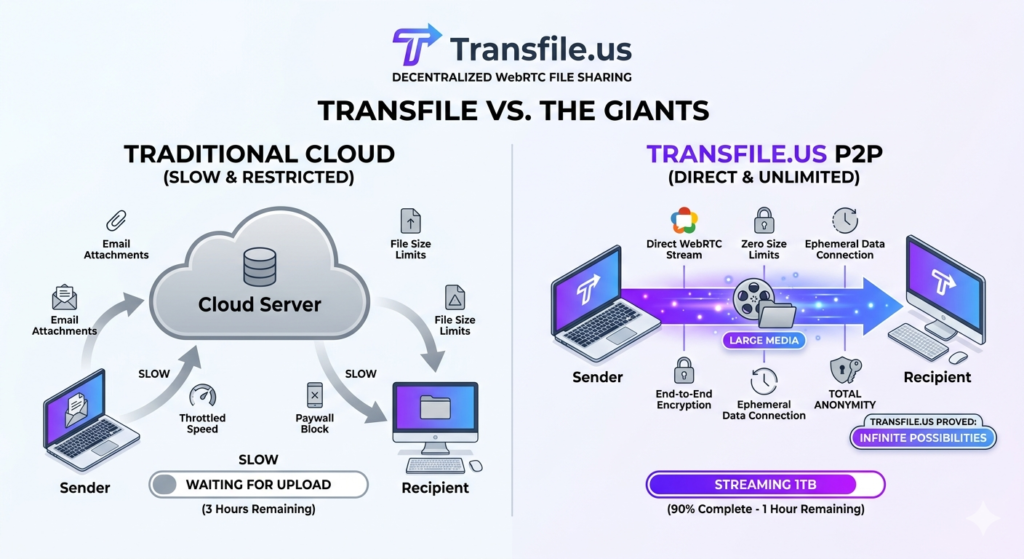
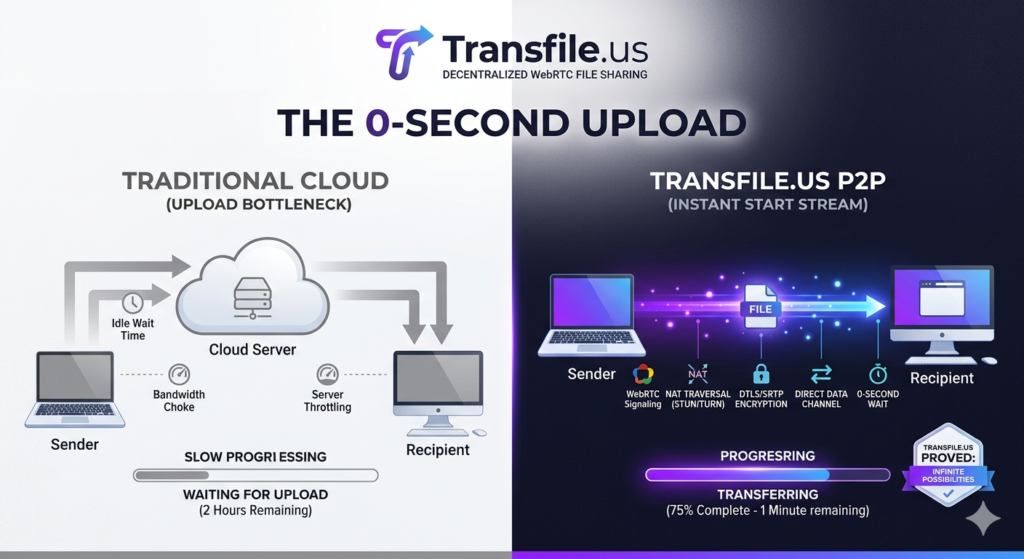
Decentralized sharing is a method of data transfer where information moves directly from point A to point B without residing on an intermediary server. On Transfile.us, this is achieved through WebRTC technology, creating a private, encrypted tunnel between two browsers.
In this model, the “server” doesn’t exist. Your computer is the server, and the recipient’s computer is the client. Once the transfer is complete and the browser tab is closed, there is no digital footprint left behind on the internet. This is what we call “Ephemeral Data Transfer.”
Why P2P is the Ultimate Security Standard
1. Zero-Knowledge Architecture
Transfile.us is built on a “Zero-Knowledge” philosophy. Because we do not store your files, we have zero knowledge of what you are sending. We cannot see your family photos, we cannot read your contracts, and we cannot sell your data to advertisers. If a hacker were to attack Transfile.us servers, they would find nothing but empty routing signals. Your actual data is never there.
2. End-to-End Encryption (E2EE) by Default
While some cloud services offer encryption as a “premium” feature, decentralized P2P sharing via WebRTC requires encryption to function. All data moving through Transfile.us is protected by DTLS (Datagram Transport Layer Security) and SRTP (Secure Real-time Transport Protocol). This ensures that even if a sophisticated actor intercepted the packets between the two peers, they would see nothing but encrypted gibberish.
3. Elimination of “Honeypots”
Centralized servers are “honeypots”—massive targets that attract hackers because the “payout” of a successful breach is enormous. Decentralized systems scatter the data. To “hack” the data on Transfile.us, an attacker would have to target each individual user’s device specifically, which is infinitely more difficult and less rewarding for mass-scale cybercriminals.
4. Data Sovereignty
Data sovereignty is the concept that your data should be subject to your own control and the laws of the country where you reside. When you use decentralized sharing, your data never leaves your physical or digital control to be stored in a data center in a different jurisdiction. You decide who sees it, and when the connection is cut, the access is gone.
The Psychology of “Serverless” Trust
Trusting a corporation is a psychological act. Trusting a decentralized protocol is a logical one. On Transfile.us, you don’t have to “trust” that we are being honest about our privacy policy. You can verify the technology: look at the network traffic, see that the file is streaming directly to your peer, and notice that no data is being sent to a storage bucket.
This transparency is the cornerstone of the next generation of the web—often referred to as Web3. It’s an internet where the user is the owner, not the product.
Use Cases for the Privacy-Conscious Professional
For Legal and Financial Advisors
Sending a sensitive contract or a tax return via email is a major security risk. Standard email is often unencrypted during various hops. Using Transfile.us ensures that the document moves directly from the lawyer to the client, encrypted, without leaving a copy in a “Sent” folder on an insecure mail server.
For Medical Professionals
Patient privacy is protected by strict laws (like HIPAA). Decentralized sharing allows doctors to share high-resolution scans or records with specialists instantly without the risk of long-term storage breaches.
For Journalists and Whistleblowers
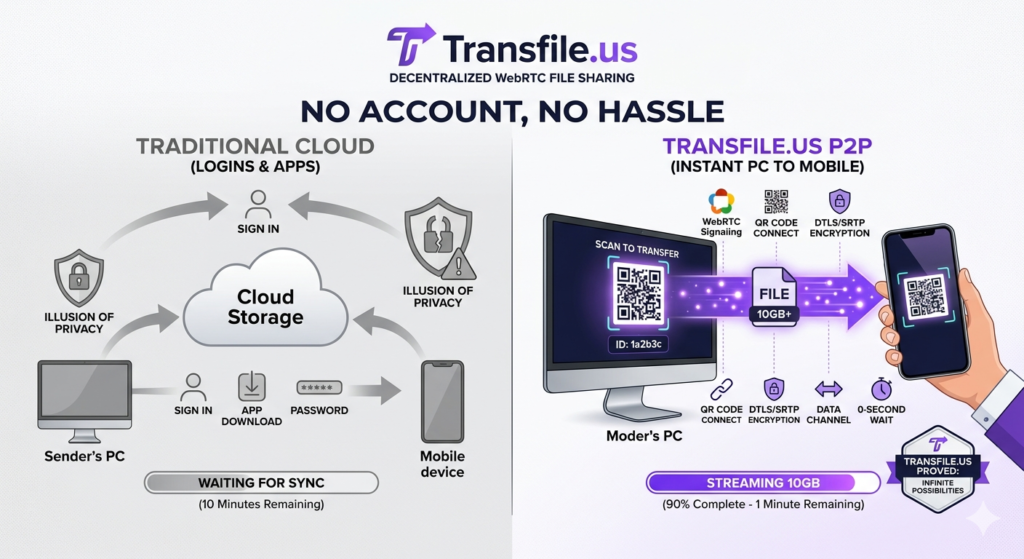
In investigative journalism, the safety of the source is everything. A decentralized, no-account platform like Transfile.us allows for the transfer of evidence without leaving a trail of metadata or account login history that could be used to identify a source.
How Transfile.us Empowers Your Digital Rights
We believe that privacy is a fundamental human right, not a luxury feature. By providing a platform that is:
- Account-Free: We don’t need to know who you are to help you share.
- Storage-Free: We don’t want your data; we just want it to get to its destination.
- Tracker-Free: We focus on utility, not on monitoring user behavior.
Transfile.us is more than just a tool; it is a statement against the over-centralization of the internet.
Conclusion: Reclaiming the Digital Fortress
The era of blindly trusting the “Cloud” is coming to an end. As data breaches become more frequent and AI-driven data mining becomes more invasive, users are looking for an exit strategy.
Decentralized P2P sharing is that strategy. It is faster, it is more efficient, and most importantly, it is private by design. Transfile.us invites you to reclaim your digital fortress. Your files should stay yours. Your privacy should remain absolute.
Take control of your data today. Experience the future of secure sharing at Transfile.us.