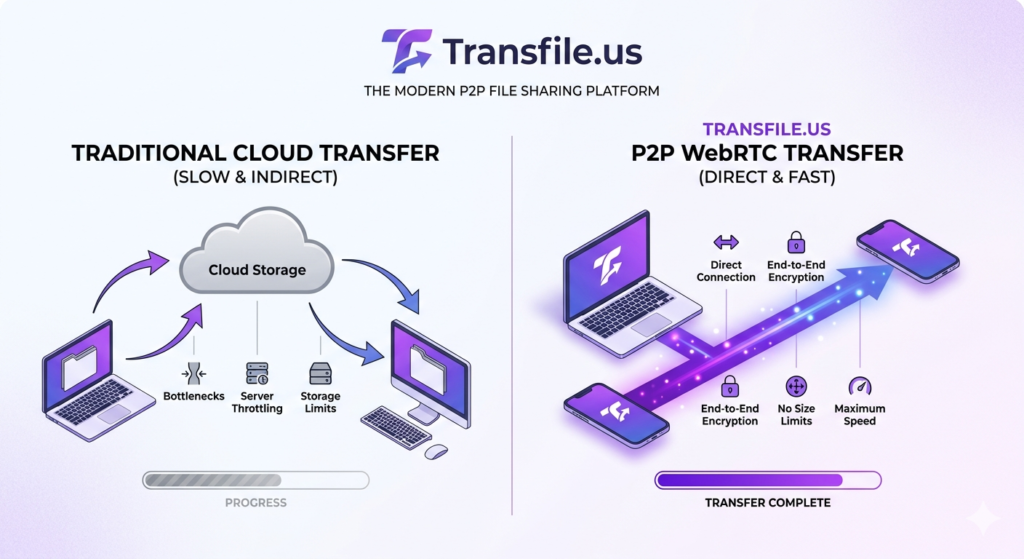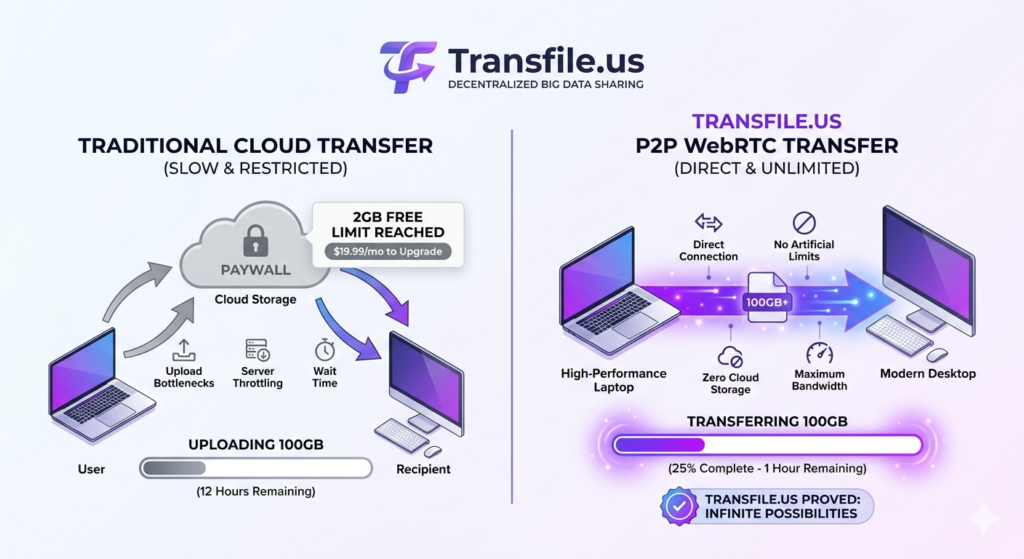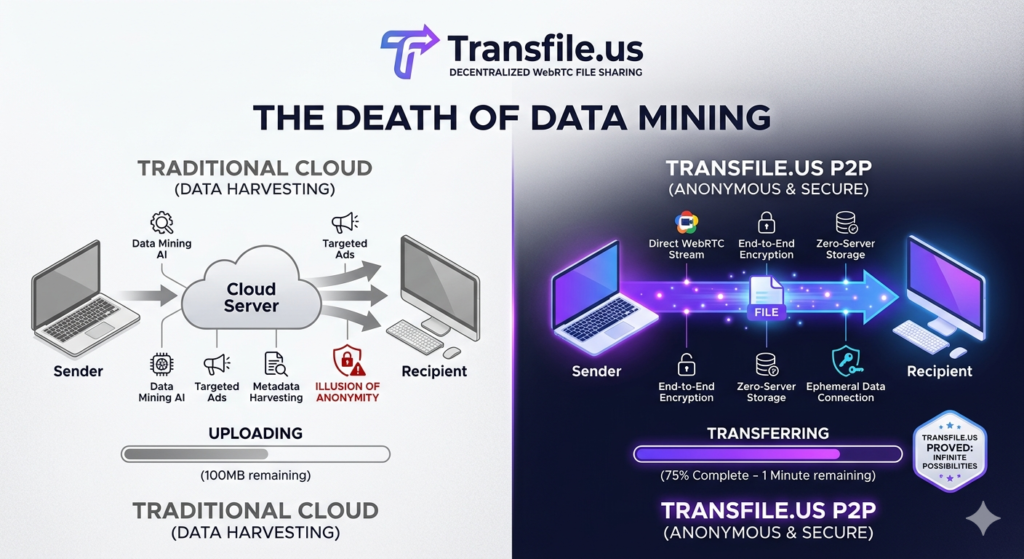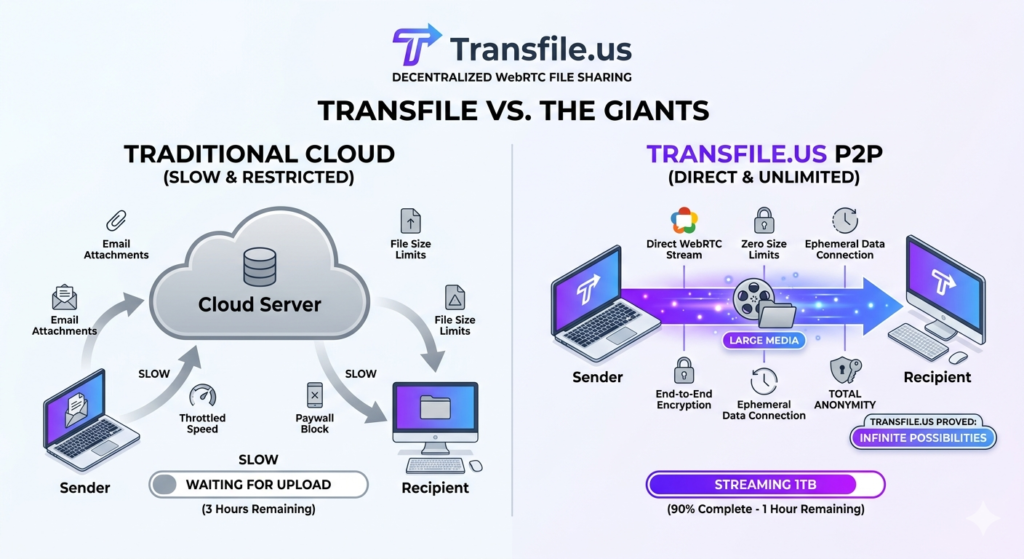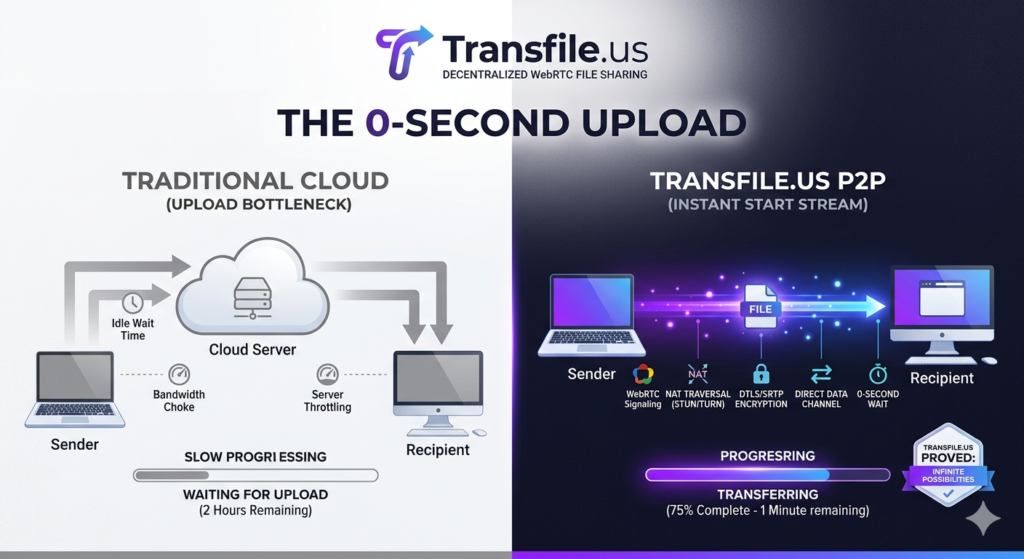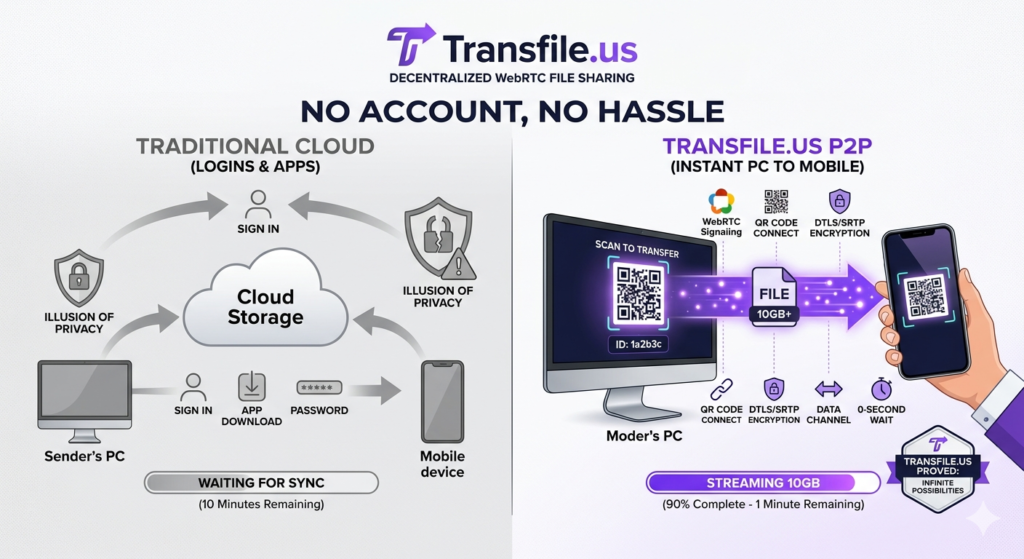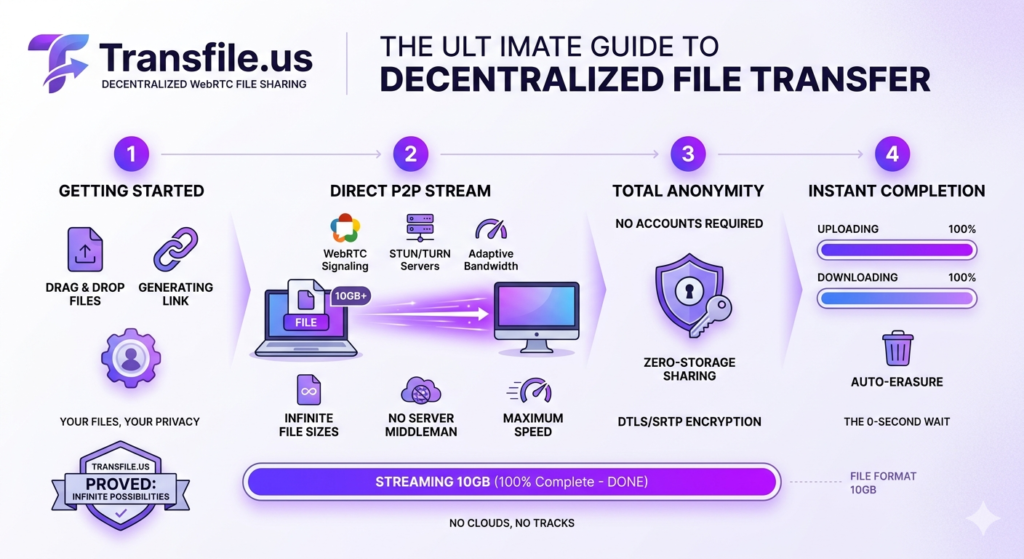
In a world where we are accustomed to “uploading” everything to a central server, the concept of Transfile.us feels almost like magic. You select a 10GB file, share a link, and it begins moving to your friend’s computer instantly—without ever being stored on a server.
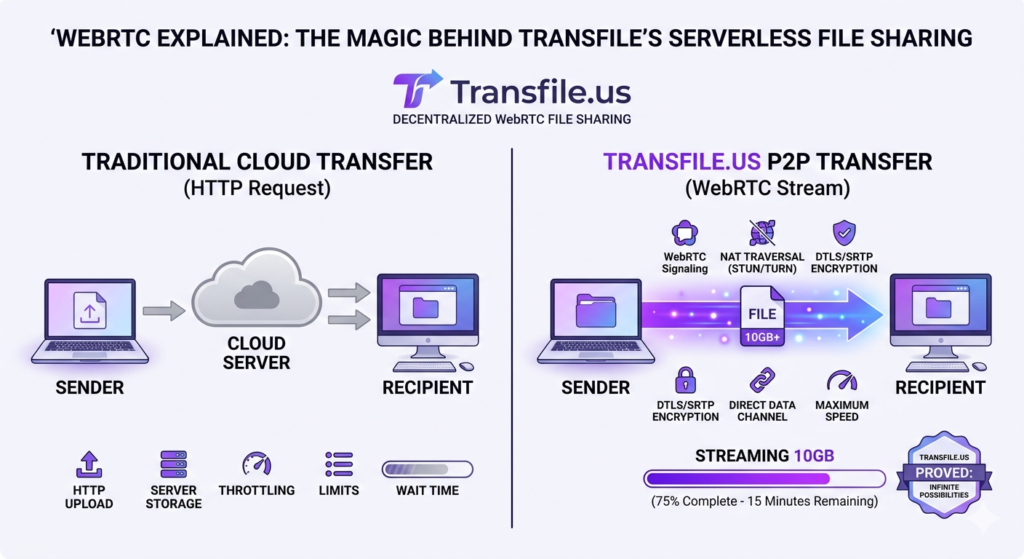
Technical diagram comparing traditional HTTP cloud file sharing versus efficient WebRTC P2P streaming on Transfile.us.
But as the famous saying goes, “Any sufficiently advanced technology is indistinguishable from magic.” Today, we’re pulling back the curtain on WebRTC (Web Real-Time Communication), the open-source project that powers the serverless revolution of Transfile.us.
What Exactly is WebRTC?
At its core, WebRTC is a collection of protocols and APIs that allow web browsers to communicate directly with each other in real-time. Originally developed by Google and now an open standard supported by Apple, Microsoft, and Mozilla, it was designed to handle high-bandwidth data like video calls, voice, and—crucially—generic data files.
Before WebRTC, if two browsers wanted to talk, they had to go through a server. WebRTC changed the rules of the game by allowing browsers to bypass the middleman.
The Three Pillars of Transfile’s P2P Engine
To make serverless file sharing work seamlessly, Transfile.us leverages three specific components of the WebRTC stack:
1. The DataChannel: The Highway for Your Files
While most people know WebRTC for Zoom-like video calls, Transfile.us utilizes the RTCDataChannel. Unlike audio or video streams that can tolerate a bit of “lag” or “glitch,” file data must be perfect. The DataChannel supports reliable, ordered delivery of binary data. Think of it as a high-speed, encrypted tunnel that stretches from your browser’s memory directly to the recipient’s.
2. Signaling: The Handshake
Even though the file transfer is P2P, the two browsers first need to find each other. This is called Signaling.
- The Process: Browser A says, “I have a file and here is my digital address.” Transfile’s lightweight signaling server passes this message to Browser B.
- The Result: Once the “handshake” is complete and the browsers know each other’s location, the signaling server steps out of the way. It never sees, touches, or stores the file.
3. NAT Traversal (STUN & TURN): Breaking Through Walls
Most computers are hidden behind firewalls or routers (NAT). Directly connecting two devices behind different routers is notoriously difficult. WebRTC uses two clever tools to solve this:
- STUN Servers: These tell your browser, “Here is your public IP address so others can find you.”
- TURN Servers: In rare cases where a firewall is extremely strict (like in a corporate office), a TURN server acts as a relay. Even then, the data remains encrypted and private.
Why “Serverless” is Superior for Privacy
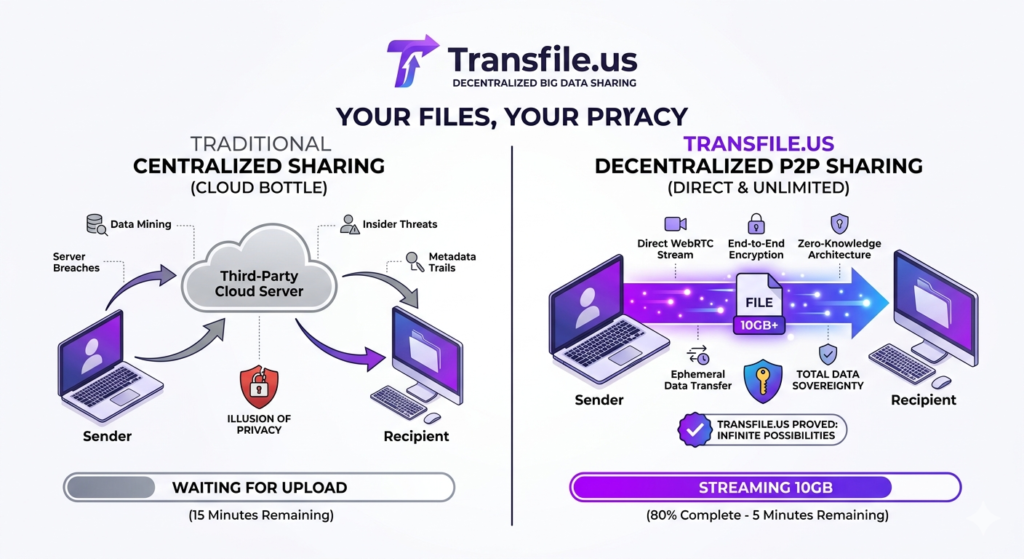
Traditional file sharing is a “Trust Me” model. You trust Google or Dropbox not to look at your files. You trust that their servers won’t get hacked.
Transfile.us operates on a “Trust Physics” model. Because we use WebRTC, the file data exists only in two places: your device and the recipient’s device.
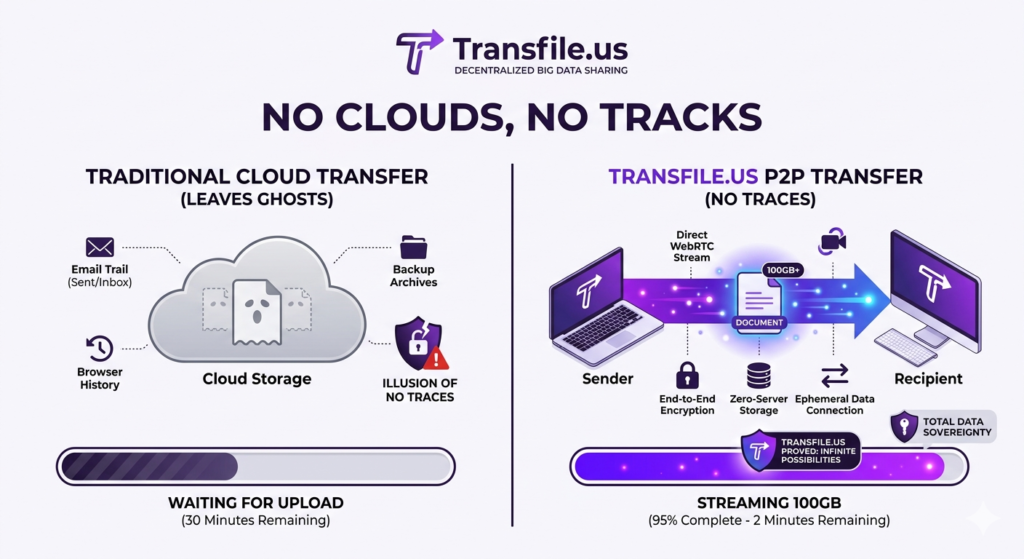
- Zero Footprint: Once the browser tab is closed, there is no digital “ghost” of your file on the internet.
- Native Encryption: WebRTC mandates encryption (DTLS and SRTP) for all connections. It’s not an optional feature; it’s baked into the code of your browser.
From Binary to Browser: The Transfer Process
When you drop a file into Transfile.us, the browser doesn’t “upload” it in the traditional sense. Instead:
- The file is broken into tiny “chunks” of binary data.
- Each chunk is encrypted locally on your machine.
- The chunks are sent through the RTCDataChannel in a continuous stream.
- The recipient’s browser receives these chunks and reassembles them back into the original file.
This “streaming” approach is why there are no file size limits. We aren’t limited by server disk space; we are only limited by how much data your connection can push through the “pipe.”
The Impact on Speed: Cutting Out the “Middleman Lag”
In a cloud-based system, speed is dictated by the server’s “write” speed. Even if you have the fastest internet in the world, the server can only receive data as fast as its hardware allows.
With WebRTC on Transfile.us, the speed is a “Direct Path.” If you are sending a file to a colleague in the same office, WebRTC is smart enough to realize you are on the same local network. It will route the data through your office Wi-Fi or Ethernet at blistering speeds, never even leaving the building. This is something no cloud provider can offer.
Challenges of the P2P Frontier
While WebRTC is powerful, it requires a different mindset from the user:
- Simultaneity: Because it’s a live stream, both parties must be online. You can’t send a link and turn off your computer (as you would with a cloud upload).
- Browser Reliability: The performance of the transfer depends on the browser’s ability to handle memory. This is why we recommend modern, updated browsers like Chrome or Firefox for the best Transfile experience.
Conclusion: Re-imagining the Web with WebRTC
WebRTC is more than just a technical protocol; it represents a shift in how the internet should work. It moves power away from massive data centers and back to the individual user.
By building Transfile.us on the back of WebRTC, we aren’t just giving you a tool to send files—we are giving you a more private, faster, and more efficient way to interact with the digital world. The “magic” of serverless sharing is actually the sound of the internet returning to its decentralized roots.
Ready to see WebRTC in action? Experience the technology for yourself at Transfile.us.