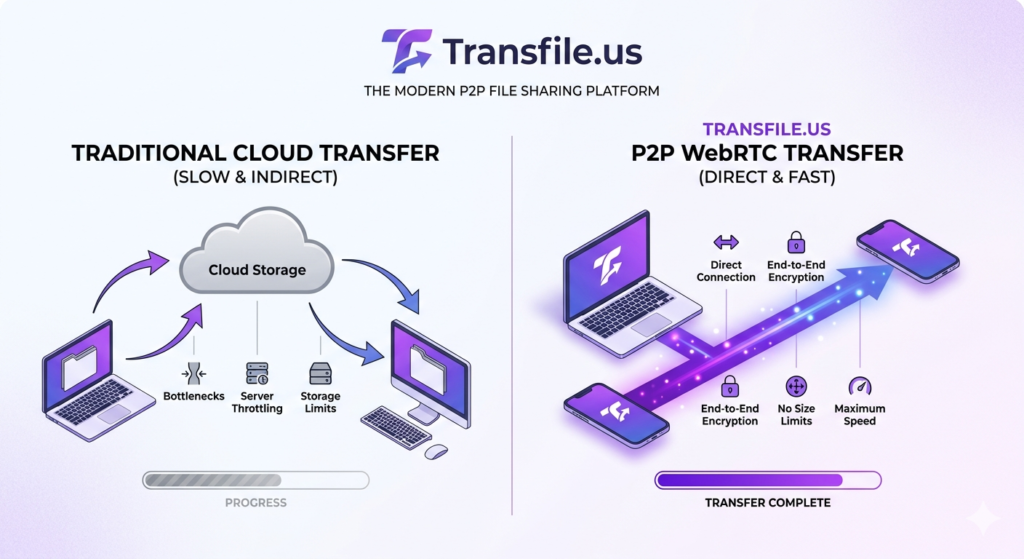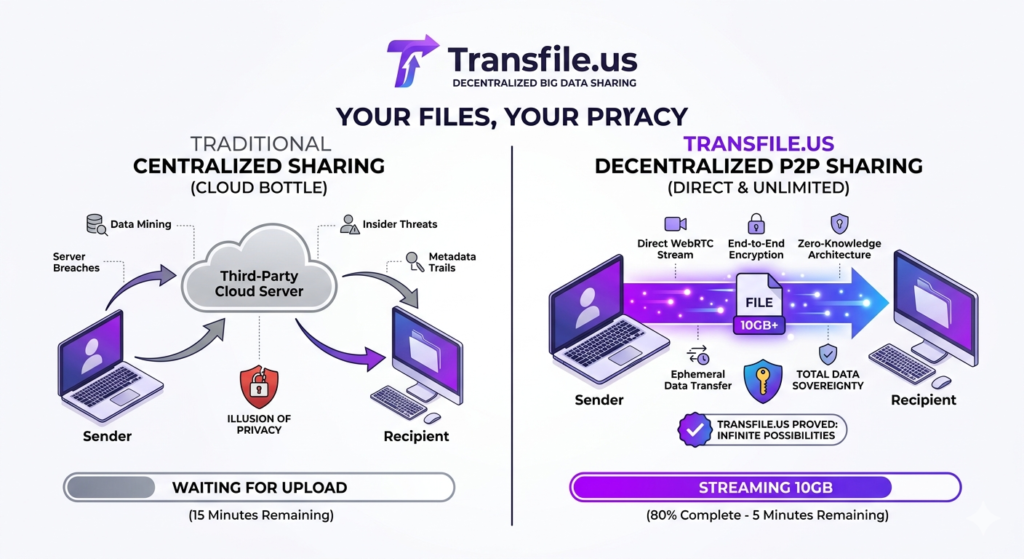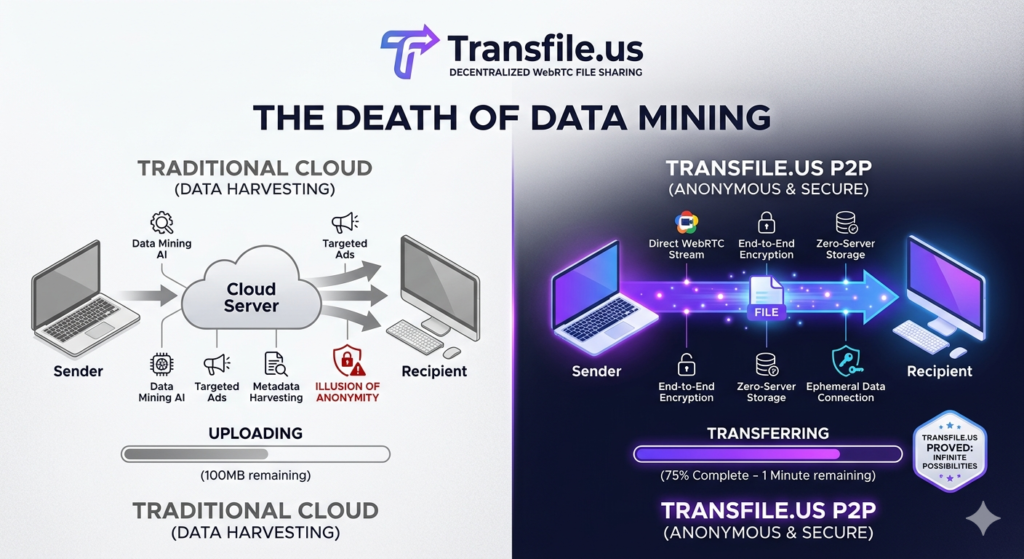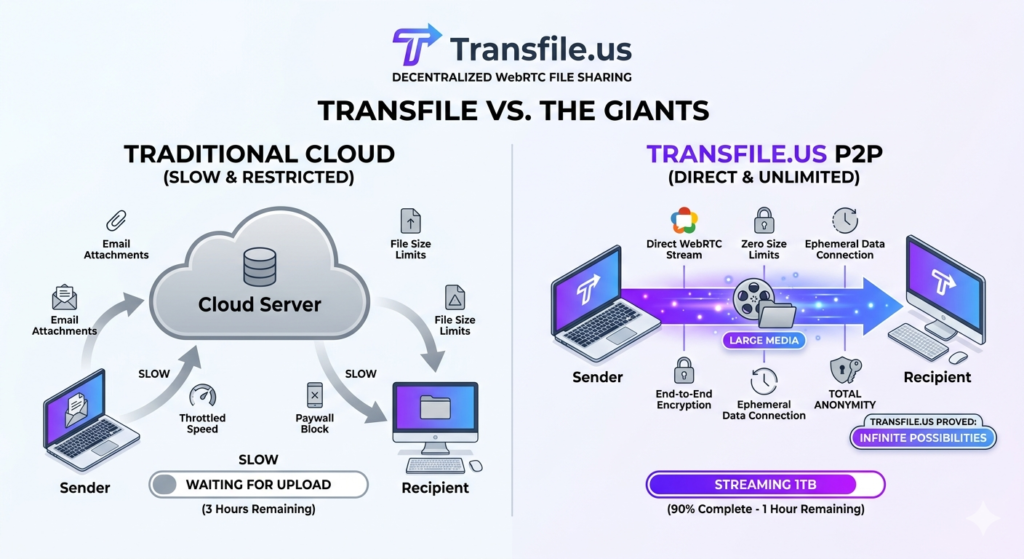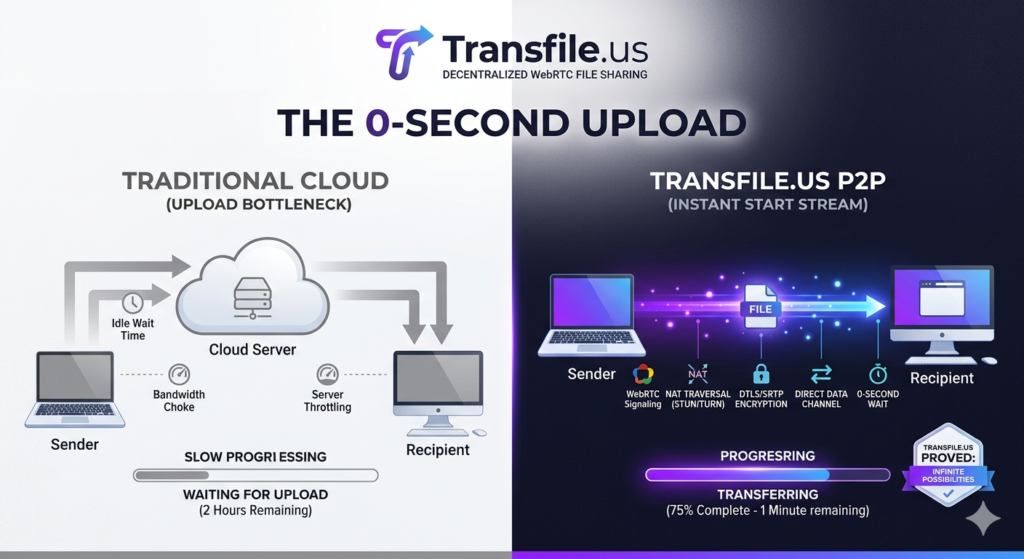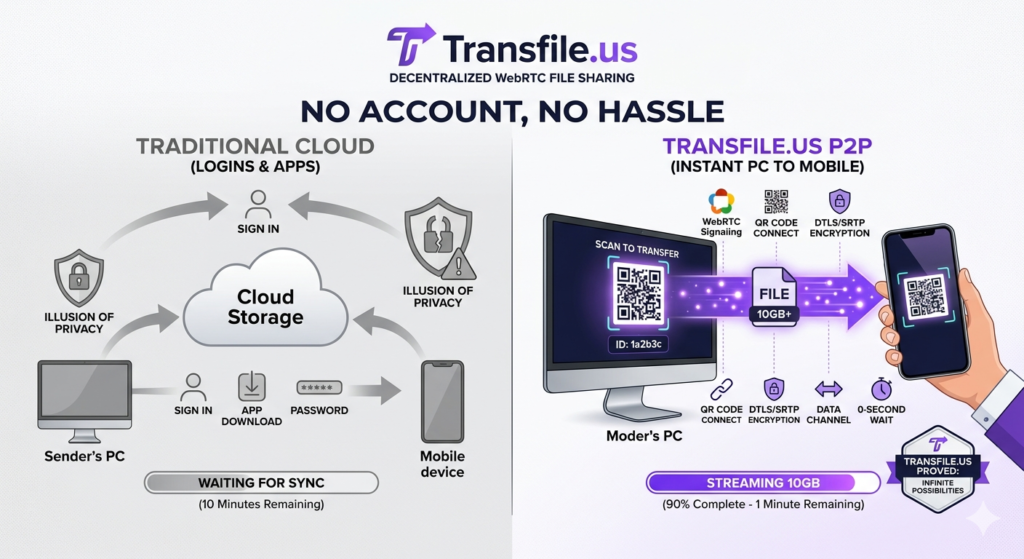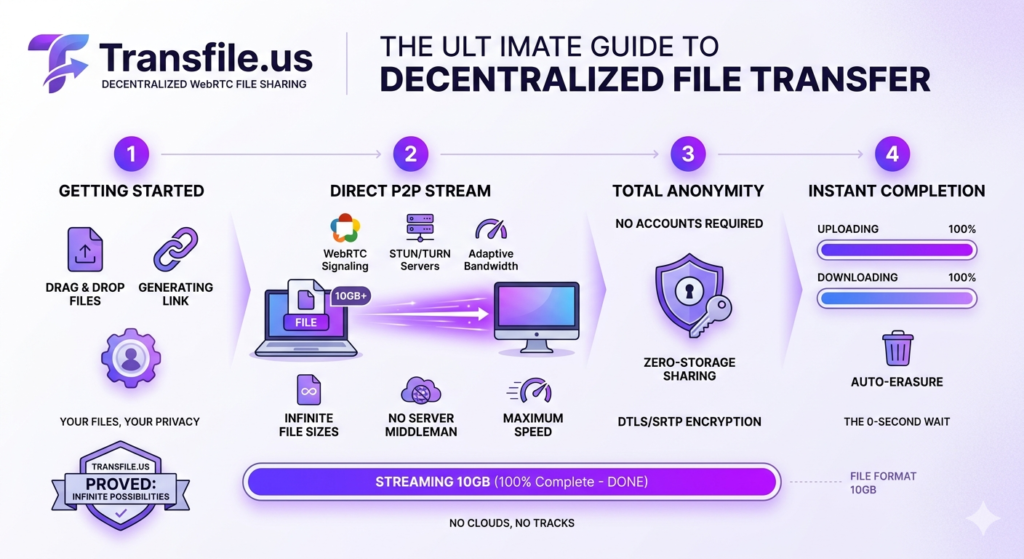
In the digital age, “deleting” something rarely means it is actually gone. When you send a sensitive document via email, a copy remains in your “Sent” folder, another in the recipient’s “Inbox,” and multiple versions sit on the servers of email providers like Google or Microsoft. If you use cloud storage, that document is indexed, backed up, and potentially scanned by automated systems. For professionals handling high-stakes information, this “digital trail” is not just a nuisance—it is a liability.
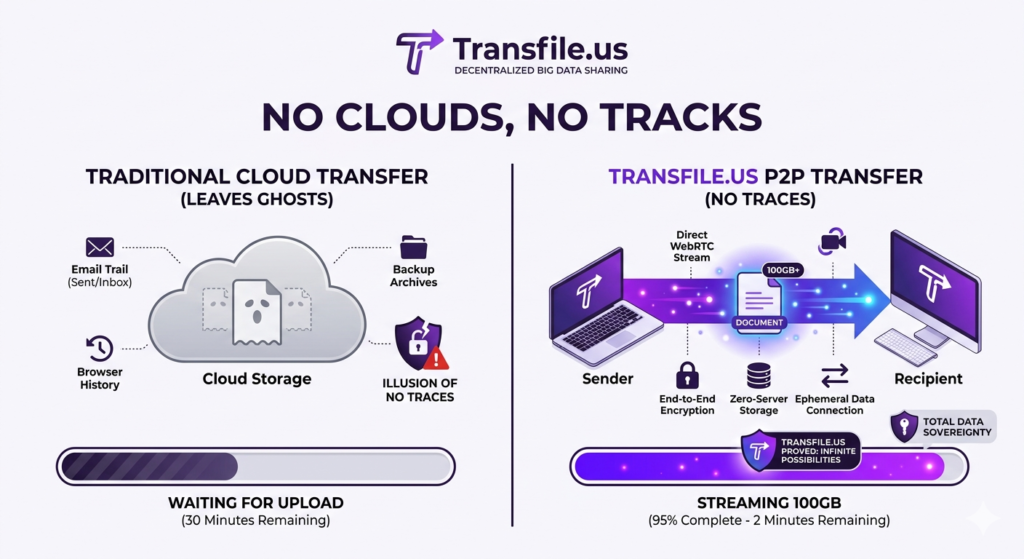
Transfile.us infographic comparing digital footprint risk versus anonymous P2P decentralized data sovereignty and no cloud tracks.
The demand for a truly private way to move data has led to the rise of Transfile.us. By eliminating the cloud and embracing a “No Tracks” philosophy, Transfile.us allows you to move sensitive documents across the globe with the digital equivalent of a face-to-face hand-off.
The Problem with the “Cloud Ghost”
Every time a file touches a server, it leaves a “ghost.” This ghost consists of metadata (who sent what, when, and from where) and the actual raw data of the file itself. Even if you delete the file later, the ghost may persist in backup archives for months or years.
For whistleblowers, investigative journalists, legal counsels, and corporate executives, these ghosts represent a permanent vulnerability. A server breach three years from now could expose a confidential contract sent today. Transfile.us solves this by ensuring the file never becomes a ghost. It exists in transit, and then it is gone.
The “No Tracks” Philosophy of Transfile.us
Transfile.us is built on the principle of Ephemeral Data Transfer. Unlike traditional platforms that act as a “Post Office” (where mail is sorted and stored), Transfile.us acts as a “Direct Pipe.”
1. No Accounts, No Metadata Ties
Most secure platforms require you to sign up. The moment you create an account, you have created a digital identity linked to your files. Transfile.us requires no registration. There is no email address to link to the transfer, no password to be compromised, and no user profile to be subpoenaed. You are a guest every time you use the service.
2. Zero-Server Storage
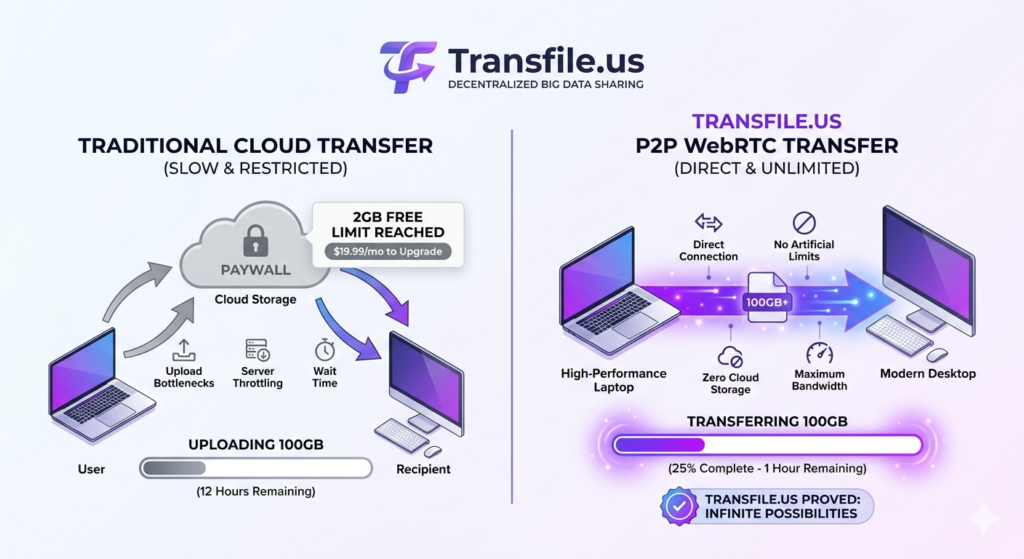
Traditional “secure” links still store the file on a server for a set period (e.g., “This link expires in 24 hours”). During those 24 hours, your sensitive document is sitting on a hard drive you do not control. On Transfile.us, the moment the transfer is 100% complete and the browser tabs are closed, the “pipe” vanishes. There is no server-side storage to hack.
3. WebRTC: The Engine of Privacy
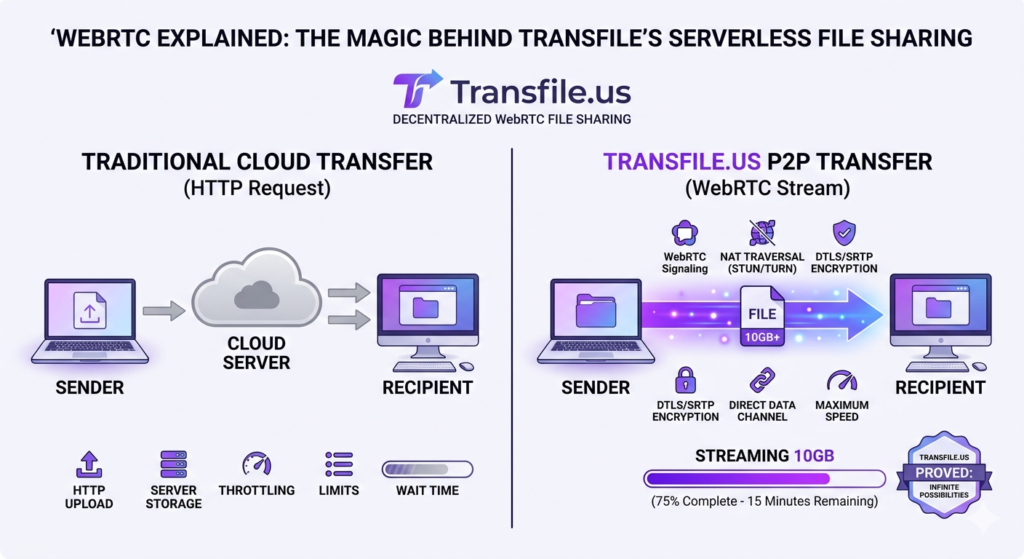
By using WebRTC (Web Real-Time Communication) technology, Transfile.us facilitates a direct connection between the sender and the receiver. The data flows directly from your RAM/Disk to theirs. Our servers only act as a “matchmaker” to help the two browsers find each other; they never see the content of the documents.
Why Sensitive Documents Require P2P Security
Sensitive documents—be they legal briefs, medical records, or proprietary source code—are prime targets for industrial espionage and data harvesting. Standard encryption is good, but Encryption + Decentralization is better.
End-to-End Encryption (E2EE)
Transfile.us utilizes the browser’s native encryption capabilities. The data is encrypted before it even leaves your device and is only decrypted once it reaches the recipient. Because it is P2P, there is no “man-in-the-middle” server that could potentially hold a master key.
Resistance to Interception
Because the transfer doesn’t follow a predictable path to a major data center (like AWS or Google Cloud), it is much harder for mass-surveillance systems to categorize and “flag” the traffic. It looks like a simple real-time data stream, similar to a private video call.
Use Cases for High-Stakes Privacy
1. Legal & Paralegal Work
Lawyers often need to share discovery documents or witness statements that are under strict protective orders. Sending these via a standard cloud link creates a risk of unauthorized access. Transfile.us ensures the document goes directly from the law firm to the co-counsel, leaving no copy on an external server that could be leaked.
2. Investigative Journalism
Protecting a source is the highest priority for a journalist. If a source sends a leak via a traditional cloud drive, the “audit log” of that cloud drive can be used to identify them. With Transfile.us, there is no audit log. The source remains anonymous, and the “track” is erased as soon as the file is received.
3. Mergers and Acquisitions (M&A)
During high-level corporate negotiations, even the knowledge that two companies are sharing files can tip off the market. Decentralized sharing minimizes the digital footprint of these interactions, keeping sensitive negotiations behind closed doors.
How to Ensure Maximum Privacy on Transfile.us
To achieve the “No Tracks” ideal, follow these best practices:
- Use Incognito/Private Mode: Open Transfile.us in your browser’s private window. This ensures that your local browser history doesn’t even record that you visited the site.
- Close the Tab Promptly: Once the recipient confirms they have the file, both parties should close the Transfile.us tab. This immediately terminates the WebRTC data channel.
- Verify the Identity: Before sending a sensitive file, confirm with your recipient (via a separate secure channel like Signal) that they are the ones holding the unique link or Device ID.
The Future of Digital Sovereignty
The trend is clear: users are tired of being tracked. We are moving toward a “Post-Cloud” world where we reclaim our digital sovereignty. Transfile.us is a pillar of this movement. We believe that your documents are your business, and the tools you use to send them should respect that.
By choosing a serverless, account-less, and decentralized path, you are not just sending a file—you are protecting a secret, a career, or a life.
Conclusion: Absolute Privacy in a Transparent World
In a world where every click is recorded, Transfile.us offers a rare “black box” for your data. No clouds to hide in, no tracks to follow—just a direct, secure, and private way to move your most sensitive information.
Whether you are protecting a corporate secret or a personal document, remember: the safest server is the one that doesn’t exist.
Ready to send securely? Experience the “No Tracks” difference at Transfile.us.